
Mahjong AQL inspection is a lot-by-lot acceptance decision, not a promise that every tile in a shipment is perfect. A buyer first defines the lot, defect classes, inspection method, and decision rule. The sample size and acceptance or rejection numbers then come from the applicable sampling plan and the agreed inspection level. That sequence matters because an AQL number on its own does not tell an inspector what to check, how to classify a defect, or who can release a rejected lot.
This guide is for brands, importers, retailers, and suppliers building a repeatable quality gate for Mahjong tiles, accessories, packaging, or complete sets. It covers lot definition, defect classes, sampling, evidence, rework, and escalation.
Define what a Mahjong AQL inspection must decide
Write the decision in one sentence before selecting a table: "Can this defined lot be released against the approved Mahjong specification after attribute inspection?" That is more useful than writing "AQL 2.5" on a purchase order. Identify the product, revision, lot boundary, inspection stage, standard, defect classes, and approver.
A sampling inspection does not replace the product specification. That document still controls tile count, dimensions, material, surface, decoration, color, fit, packaging, labels, and market requirements. Sampling describes how part of a defined lot is examined and how the result is used.
| Control item | Question to answer | Evidence to retain |
|---|---|---|
| Product identity | Which SKU, market version, material, artwork, and packaging revision is being inspected? | Approved specification and revision record |
| Lot boundary | What quantity, production window, line, colorway, or packaging version makes one lot? | Production and packing records |
| Inspection stage | Is the check for incoming material, in-process output, finished goods, or pre-shipment release? | Inspection request and timing |
| Defect classes | Which conditions are critical, major, minor, or otherwise unacceptable? | Defect catalogue with photos |
| Sampling rule | Which standard, edition, inspection level, and normal/tightened/reduced state apply? | Referenced plan and decision table |
| Decision owner | Who can accept, reject, quarantine, or approve a documented deviation? | Named approver and signed report |
Understand what AQL does and does not mean
AQL is commonly used within acceptance sampling by attributes. ASQ describes ANSI/ASQ Z1.4 as an acceptance sampling system for a continuing stream of lots, with normal, tightened, and reduced plans. The sampling plan uses the lot size and selected inspection parameters to determine a sample and a decision rule.
"It provides tightened, normal, and reduced plans."
Do not describe AQL as the percentage of defects a supplier is allowed to ship or as a guarantee that a lot contains no defects. A sample can support release while the contract still requires critical defects to be absent, every set to be complete, or measurements to stay within tolerance.
Use a separate control when the risk requires 100% checking. Examples may include count completeness for a small set, a required label, a safety-related component, a customer-specific artwork feature, or a known defect that cannot be accepted by sampling. The buyer and supplier should agree which characteristics are sampled and which are checked on every unit.
Choose the current standard and inspection state
Many buyers refer to ANSI/ASQ Z1.4 or the ISO 2859 series. The applicable document, edition, and contractual use should be confirmed before the purchase order is released. ISO's current catalogue lists ISO 2859-1:2026 for sampling schemes indexed by AQL for lot-by-lot inspection and notes that it replaced the previous 1999 edition. A buyer using an older internal table should verify that it matches the standard named in the contract.
"ISO 2859-1 uses AQL to determine sample sizes and acceptance/rejection thresholds."
Do not mix tables from different standards or editions. Define the inspection level, code-letter method, single/double/multiple plan, and lot history that changes normal inspection to tightened or reduced.
Set lot boundaries that an inspector can verify
A lot should be homogeneous enough for the sample to represent it. A single lot might be one SKU produced under one approved artwork, material, back color, and packaging revision within a defined production window. Combining several colorways or revisions to reach a larger quantity can hide a problem rather than improve the inspection.
Ask for the lot number, production dates, work order, quantity packed, carton range, and split-shipment information. Record several lots separately or state the approved grouping logic. The report should trace a failed sample back to production and packing records.
For a Mahjong set, distinguish the tile body from the complete retail pack when they were produced at different times. The inspection record should show those interfaces; a finished-set decision that ignores its packaging revision is incomplete.
Build defect classes from the buyer's real risks
Defect classes should be defined in the specification or inspection agreement, not invented by an inspector at the table. A critical defect may be a condition that creates a safety, legal, or fundamental product risk. A major defect may prevent normal play, make the product unsellable, or break an important customer promise. A minor defect may be cosmetic or functional variation that does not stop intended use but still has an agreed limit.
The labels need concrete examples. A wrong face, missing tile, sharp edge, crack, incorrect back, warp, unreadable decoration, or incompatible size may belong to different classes by product and market. The buyer should approve the classification and provide reference images.
| Inspection area | Possible observation | How to make the result repeatable |
|---|---|---|
| Completeness | Missing tile, wrong count, incorrect special piece, or mixed version | Use a bill of materials and a fixed counting sequence |
| Dimensions and fit | Height, width, depth, flatness, or rack/insert interface outside the approved range | Record the measuring tool, method, tolerance, and sample identity |
| Decoration | Wrong artwork, poor registration, shallow engraving, incomplete fill, or unreadable face | Compare against released artwork and approved physical reference |
| Surface and body | Crack, chip, stain, sharp edge, void, gloss variation, or contamination | Use controlled light and defect reference photographs |
| Accessories | Wrong rack, dice, pusher, mat, rulebook, or incompatible component | Check the accessory list, quantities, and interface fit |
| Packaging and labels | Weak insert, abrasion risk, wrong barcode, damaged carton, or missing warning | Inspect the packed set against the approved dieline and pack-out |
Choose a sample that represents the lot
Once the lot and plan are fixed, the inspector should draw the sample using a method that avoids convenience bias. Do not take every piece from the easiest carton, the top layer, or the first pallet position. Spread the selection across cartons or production positions according to the agreed method and record which units or cartons were selected.
Confirm whether the plan counts nonconforming units or individual nonconformities. One tile can have two observations, while one incomplete set can fail a completeness rule. State how defects are recorded and how acceptance is applied before inspection.
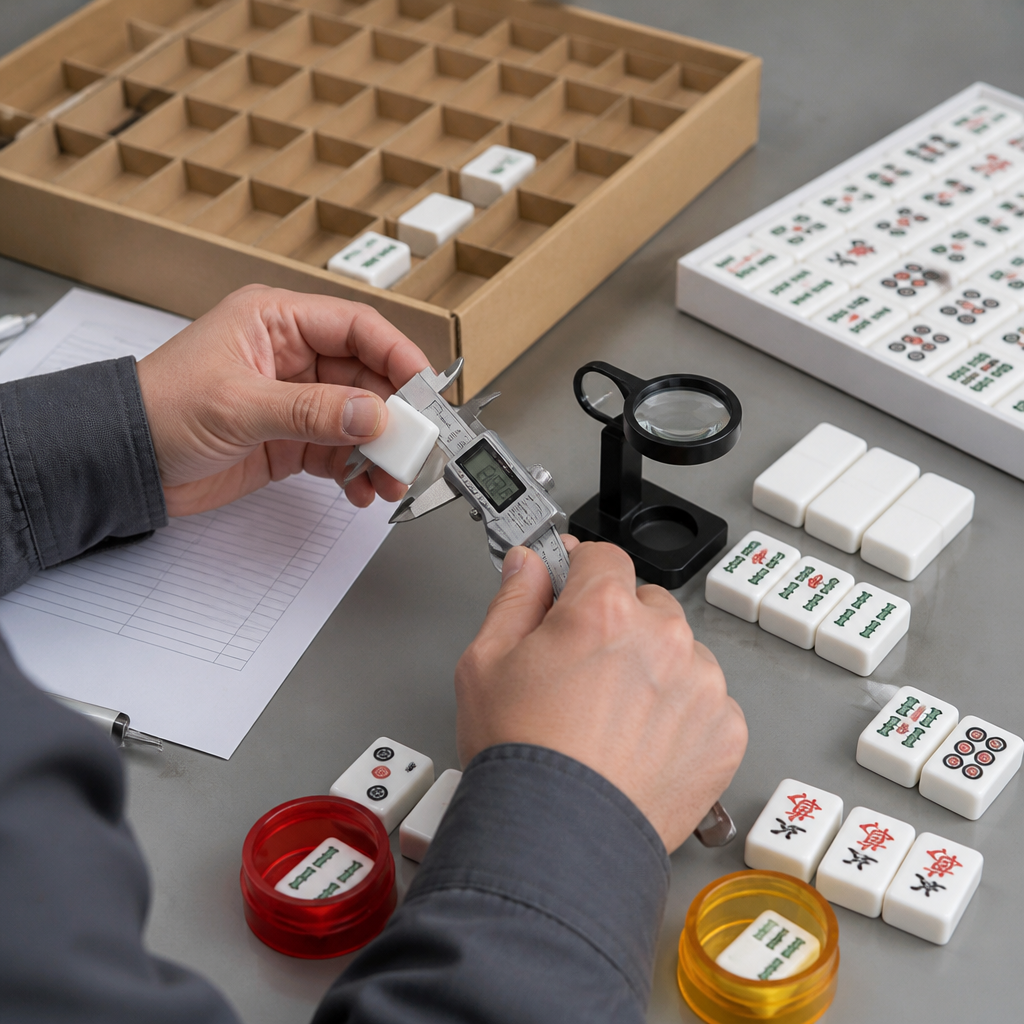
For variables such as dimensions or weight, the team may need a different method from attribute checks such as pass/fail decoration. Use the method the agreed standard supports and ensure the measurement system is suitable for the tolerance. A caliper reading without a defined point, pressure, calibration status, or tolerance is weak evidence.
Run the inspection in a fixed sequence
A repeatable sequence reduces missed checks and makes reports easier to compare. Start by verifying the lot identity and sample selection. Then inspect the sample in the same order: count and configuration, body and surface, dimensions and fit, artwork and color, accessories, packaging, and labels. Photograph unusual defects with the sample ID or carton reference visible in the record.
Use the approved sample for color, gloss, edge treatment, and decoration; the released drawing for dimensions and tolerances; and the bill of materials for count and accessories. A general product photo is not enough.
When inspection finds a defect, record location, class, quantity, sample unit, evidence, and disposition. If it is outside the plan, flag it for a buyer decision and update the control document before the next lot.
Make the report useful after the shipment
An AQL report should allow a person who was not present to understand what was checked and why the decision was made. Include the purchase order, SKU, revision, lot quantity, sample quantity, standard and edition, inspection level, code letter, AQL values by defect class, acceptance and rejection numbers, actual findings, photographs, measurements, packaging observations, and final disposition.
Also record the inspector, date, location, equipment identifiers, calibration status where relevant, supplier response, and buyer approval. If conditional, state the condition, owner, due date, and closing evidence. "Passed AQL" alone does not show whether artwork, packaging, completeness, or dimensions were checked.
Use the Mahjong tile quality inspection checklist to connect sampling with a broader review of material, dimensions, decoration, completeness, and packing. AQL belongs inside the quality system, not as a standalone number.
Handle a rejected or disputed lot
When a lot is rejected, quarantine the affected quantity and preserve the original evidence. Ask the supplier for a containment and root-cause response, not only a promise to sort. The response should identify whether the issue came from artwork revision, material, machine setup, handling, packing, or a counting mistake.
Agree how rework, 100% sorting, resampling, replacement, or a documented deviation will be handled. A second sample should not silently use a new acceptance rule. Record whether the reinspection is for the original lot, a reworked lot, or a new lot, and which costs or schedule effects belong to each party.
If a buyer accepts a deviation, describe the exact scope and expiry. A one-time acceptance for a cosmetic variation should not become an unrecorded production standard. The custom Mahjong service page and contact route can be used to share the approved specification, sample questions, and required evidence before a new project reaches shipment.
Connect AQL with the rest of the release process
Sampling works best when linked to earlier controls. Release the face schedule and material, retain a golden sample, confirm packaging fit, inspect first output, and then apply the lot plan. If the product changes, review the lot definition, defect catalogue, and inspection plan.
For private-label programs, keep the sample, artwork, packaging dieline, inspection report, and approval message under one revision. The artwork preparation guide helps organize production files, while the sample approval workflow defines how evidence moves from prototype to release.
FAQ
What does AQL mean in a Mahjong inspection?
AQL is part of an acceptance-sampling system used to select a sample and apply an acceptance or rejection rule to a defined lot. It is not a promise that every unit is defect-free or a simple allowance of defects.
Can a buyer choose AQL 2.5 for every Mahjong product?
Not as a universal shortcut. The buyer must define product risks, defect classes, lot structure, applicable standard, inspection state, and any characteristics that require 100% checking or a stricter contractual rule.
Does AQL replace a complete-set count?
Not automatically. If every retail set must contain a fixed configuration, define how completeness is checked and whether it is sampled or verified on every set. A sample plan does not erase a contractual count requirement.
Should critical defects have an acceptance number of zero?
Many buyers require no critical defects, but the exact rule belongs in the approved specification and contract. Define the class, evidence, containment step, and release authority before inspection.
What is the difference between normal and tightened inspection?
They are different states in a switching system. The applicable standard and documented lot history determine when the state changes. Do not switch informally because one result is inconvenient.
How should a lot be defined for different tile colors?
Keep colorways separate when material, artwork, process, or risk differs. If lots are combined, document why the grouping is homogeneous and how the sample represents each component.
Can an inspector use a photo instead of a golden sample?
A photo helps document a condition, but it may not show gloss, depth, feel, fit, or actual color. Use the approved physical sample for characteristics that depend on the physical product.
What happens after an AQL rejection?
Quarantine the lot, preserve evidence, agree on sorting or rework, identify the root cause, and define the reinspection rule. Record whether the next inspection covers the original, reworked, or replacement lot.
Should a report list every defect found?
Yes. Record sample identity, defect class, location, quantity, photographs, measurements where relevant, and disposition. The report should support both the release decision and future corrective action.
Where can a buyer request an AQL inspection plan?
Send the SKU, lot structure, specification, artwork revision, packaging, target market, defect examples, desired inspection stage, and required report format through the project inquiry route.
Turn the sampling table into a controlled release
Mahjong AQL inspection is useful when it is attached to a defined lot, a clear defect catalogue, a verified sampling plan, and a report another person can audit. Confirm the applicable edition of the standard, avoid inventing fixed sample numbers, and reserve full checks for characteristics where sampling does not provide enough protection.
For a new or repeat program, review ABC Mahjong company information and send a project inquiry with the product specification, lot size, inspection stage, defect priorities, packaging version, destination, and required evidence. That gives the supplier a concrete basis for preparing a quality gate rather than quoting an unexplained AQL number.