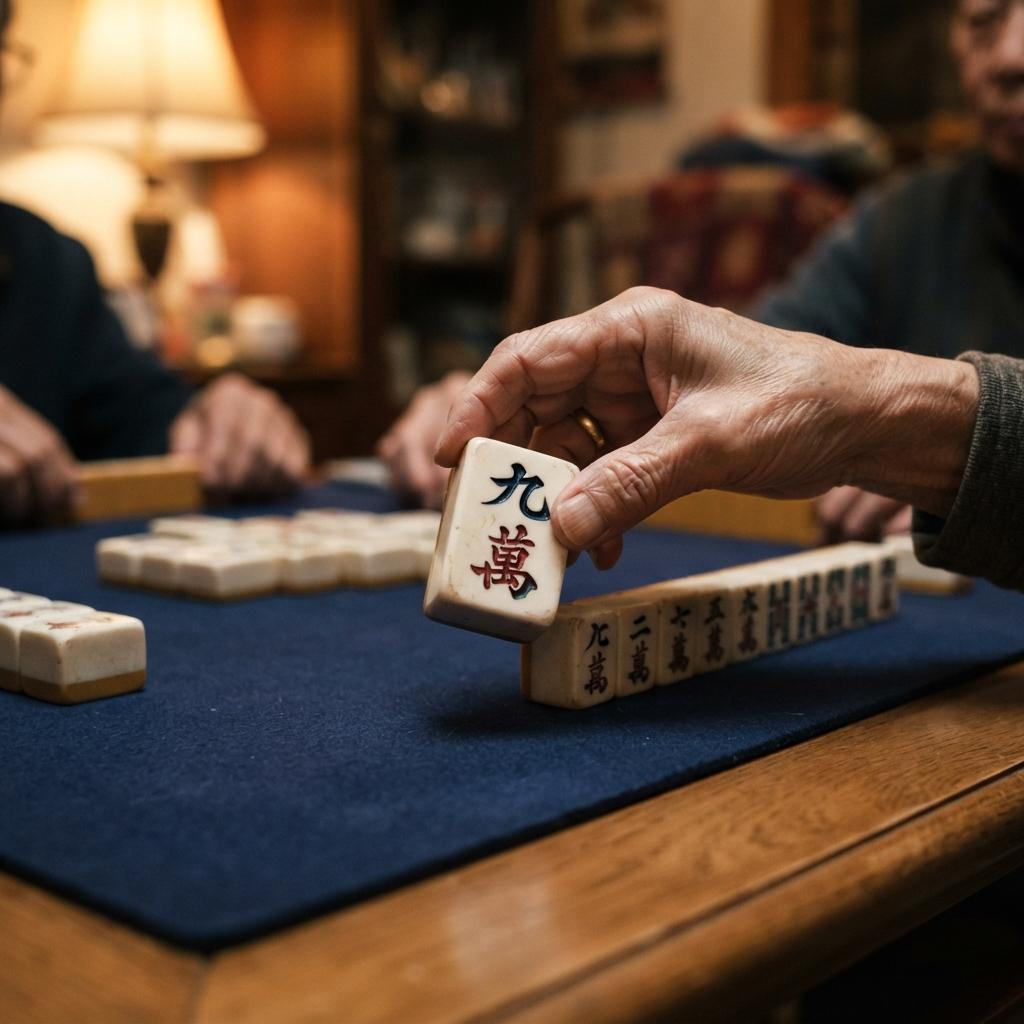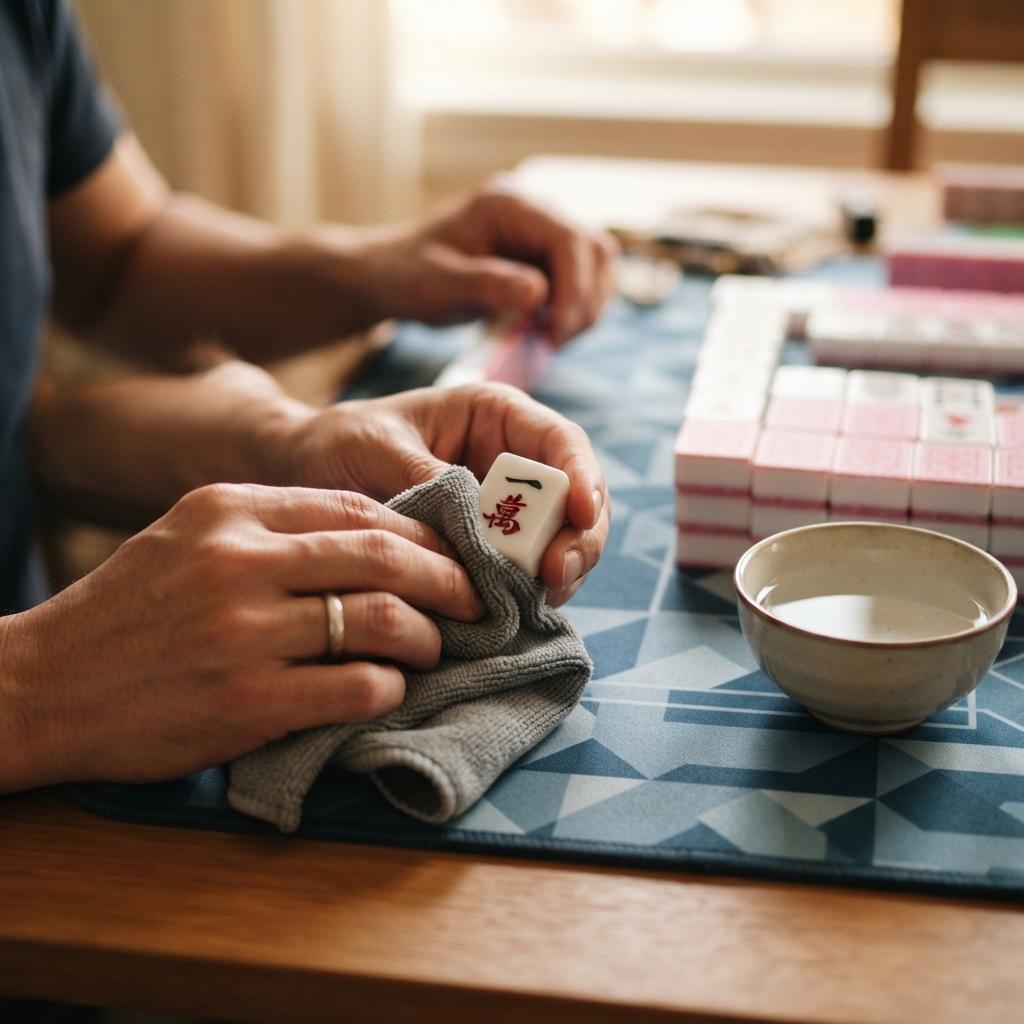

Mahjong tiles for seniors work best when the tile is large, the symbol contrasts strongly with the face, and the edge is easy to pick up. Those three specifications do more for comfortable play than any other feature, because they address the two things that change with age: how much detail the eye resolves at table distance, and how much grip and reach the hand has.
Most advice on mahjong tiles for seniors stops at "buy a large set". That is only half the answer. A large tile with pale gold symbols on a cream face can be harder to read than a smaller tile with dark symbols on a plain white face. This guide covers size, contrast, grip, lighting and the accessories that actually help, so you can check a set on the table instead of guessing from a product photo.
Why tile size matters more than most buyers expect
Mahjong is played at arm's length. Four players sit around a table, tiles stand in racks or lie face up in a wall, and the symbol you need may be 50 to 70 cm from your eye. At that distance a small symbol on a busy face blurs, and no amount of squinting restores the edge definition. A larger face gives the same artwork more physical space, which usually means thicker strokes, wider gaps between lines and a bigger overall silhouette.
This is why mahjong for low vision players is mostly a conversation about dimensions rather than about rules. Size also changes the physical layout of the game. A 144-tile set puts 36 tiles on each side of the wall, or 18 stacked pairs. A 152-tile American set puts 38 on each side, or 19 pairs. Larger tiles make that same wall longer and taller, which matters when the table is small, when a player's reach is limited, or when someone is playing from a wheelchair at a fixed height.
What "large" actually means when you shop
"Large" is a marketing word, not a specification. Two sets sold as large mahjong tiles can differ by several millimetres across the face.
| Format | How it is usually described | What to confirm before you buy |
|---|---|---|
| Standard | No size label; often the default in general listings | Face width and thickness in millimetres or inches |
| Large or tournament | Sold as large, club or tournament size | Exact face dimensions and weight per tile |
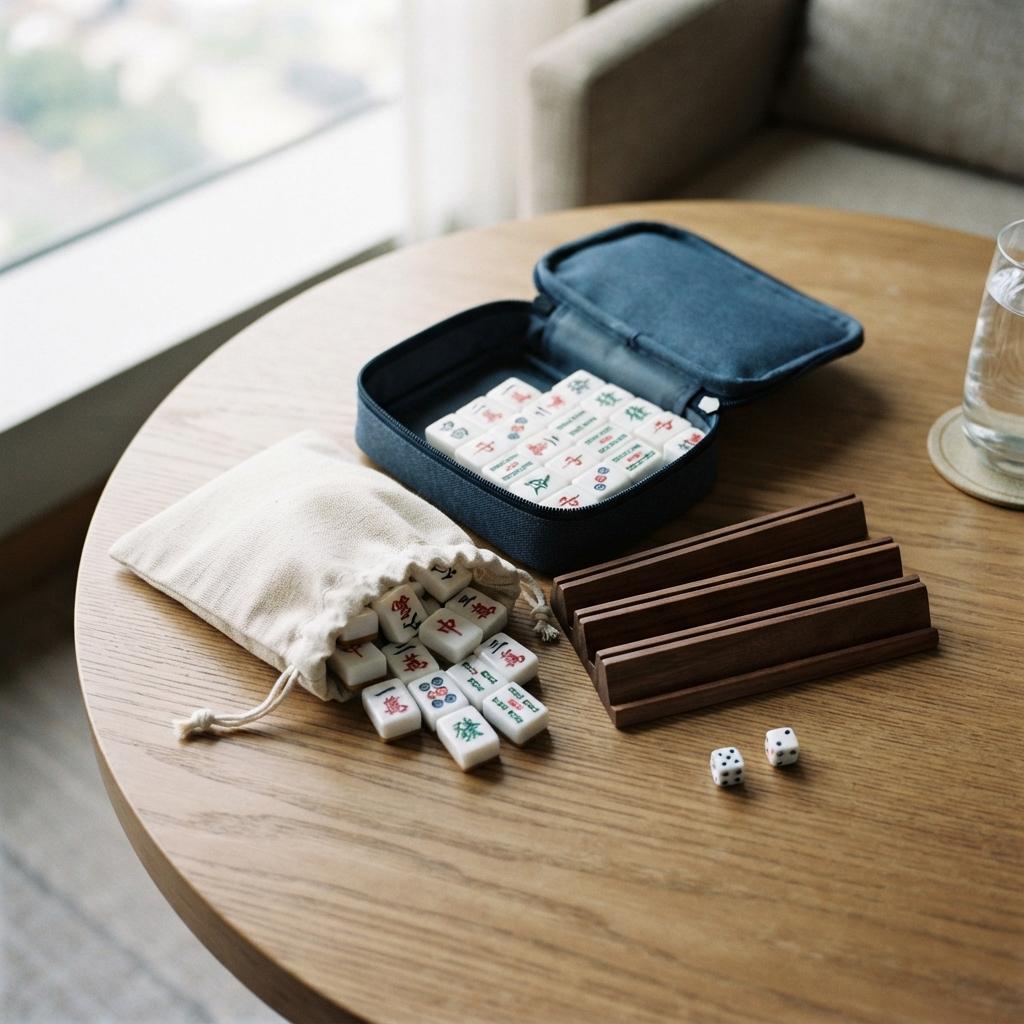
| Travel or mini | Compact, magnetic or folding sets | Whether the tile still stacks in 18 to 19 pairs |
Dimensions appear in either inches or millimetres depending on the supplier, and they vary by mould. Ask for the specification in writing rather than measuring a photo. Our Mahjong tile size guide explains how mahjong tile size, thickness and rack fit interact, which is the part most listings leave out.
Contrast is the biggest lever you can control
The American Foundation for the Blind's guidance on environments for older people with vision loss centres on three factors: lighting, colour contrast and glare reduction. It recommends placing light objects against a dark background so the edge of the object is easy to find. On a Mahjong table the same rule applies in both directions, at two levels.
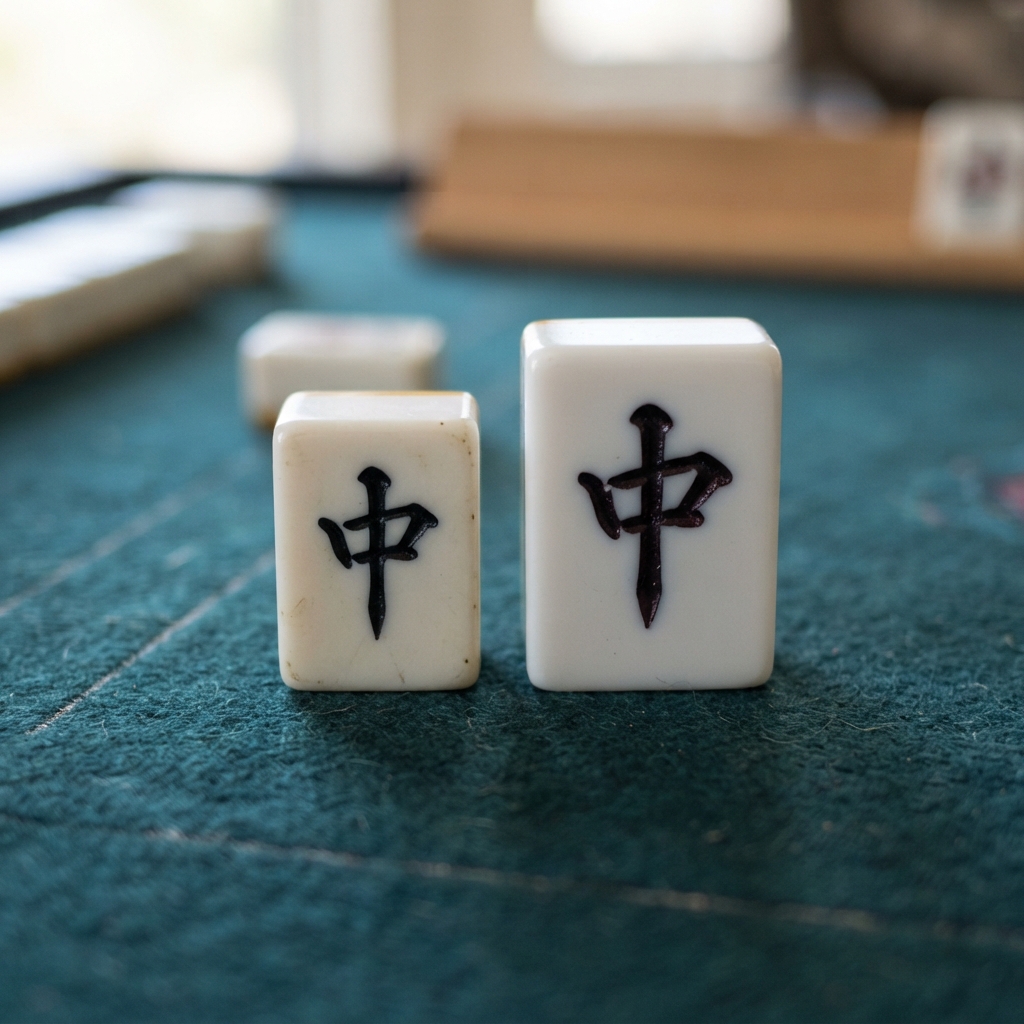
- Symbol against face. A dark symbol on a plain white face reads more reliably than pale pink, gold or silver artwork on white, especially under warm indoor lighting.
- Tile against table. Light tiles on a dark mat are easier to locate than light tiles on a pale wooden table, because the tile edge never disappears into the background.
- Glare. A glossy face reflects a ceiling light straight back at the player, which reduces contrast exactly where the eye needs it.
Contrast is not the same as colourfulness. A face printed in six bright colours can have lower usable contrast than a two-colour face, because the eye has to separate the symbol from its own decoration. High contrast mahjong tiles are therefore a design decision, not a product category: dark strokes, a plain background and a finish that does not reflect the room light. When you compare two sets, photograph one tile from each at roughly 50 cm and look at the images side by side. If the symbol stops reading clearly at that size, it will not improve in a dim room.
Grip, weight and hand fatigue
A Mahjong session involves picking up, stacking and moving tiles hundreds of times. Three details decide whether that feels comfortable or tiring.
Corner radius. Rounded corners are easier on the fingers than sharp ones and less likely to chip. Thickness. A thicker tile gives the thumb and forefinger more to hold, which matters for anyone with arthritis or reduced grip strength; thickness helps more than a lighter weight. Surface finish. A high-gloss face looks premium but shows fingerprints quickly and becomes slippery when hands are warm; a satin or matte finish hides marks and gives more friction.
Weight is a trade-off rather than a target. A denser tile feels solid in the hand but is heavier to lift all evening. For a club set that is moved between tables, weight per tile also affects how heavy the case becomes, so ask for the packed weight as well as the tile dimensions.
Lighting and table setup
Lighting does as much work as the tile itself. Aim for light from the side rather than straight overhead, so the reflection lands away from the symbol. Avoid sitting with a bright window behind you, which turns the tile face into a silhouette. A simple adjustable lamp placed beside the table, rather than above it, is often enough.
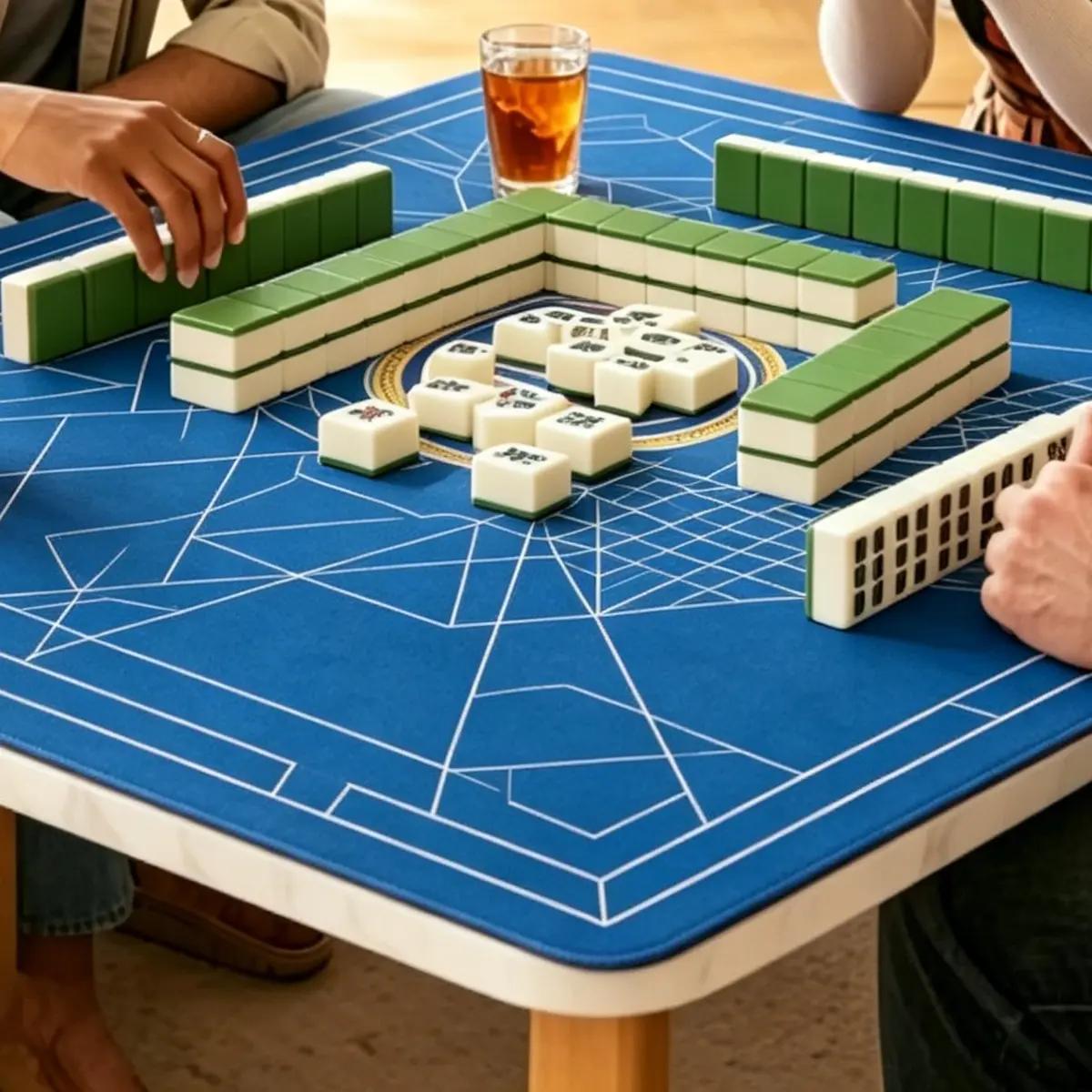
Mahjong mat contrast matters as much as tile contrast. A mat helps in three ways: it defines the play area so tiles do not drift, it softens the impact noise of shuffling, and it stops tiles sliding on polished or glass tabletops. Choose a mat colour that contrasts with the tile back, not the tile face. If the set has pink or white backs, a mid-tone or dark mat separates the pieces clearly at the edge of vision.
Accessories that make a real difference
Racks and pushers are not extras for older players; they change the ergonomics of the game. A rack holds 13 tiles upright at a fixed angle, so nobody has to hold a hand of tiles or fan them in one palm. A pusher moves a completed wall without reaching across the table. Together they reduce the two movements that cause most strain: holding and over-reaching.
If space is tight, check the rack length against the tile format. A large tile on a standard rack overhangs and can tip, which defeats the purpose.
How to compare mahjong tiles for seniors before you buy
| Check | Why it matters | How to test it |
|---|---|---|
| Symbol size relative to the face | Thin artwork disappears at table distance | View one tile from about 50 cm in normal room light |
| Symbol and face contrast | Pale on pale is the most common readability problem | Compare two sets in the same light, not from separate photos |
| Corner radius and edge | Sharp corners chip and are harder to lift | Pick up ten tiles in a row and notice the pinch point |
| Thickness | Grip comfort and wall height | Stack 19 tiles and check stability |
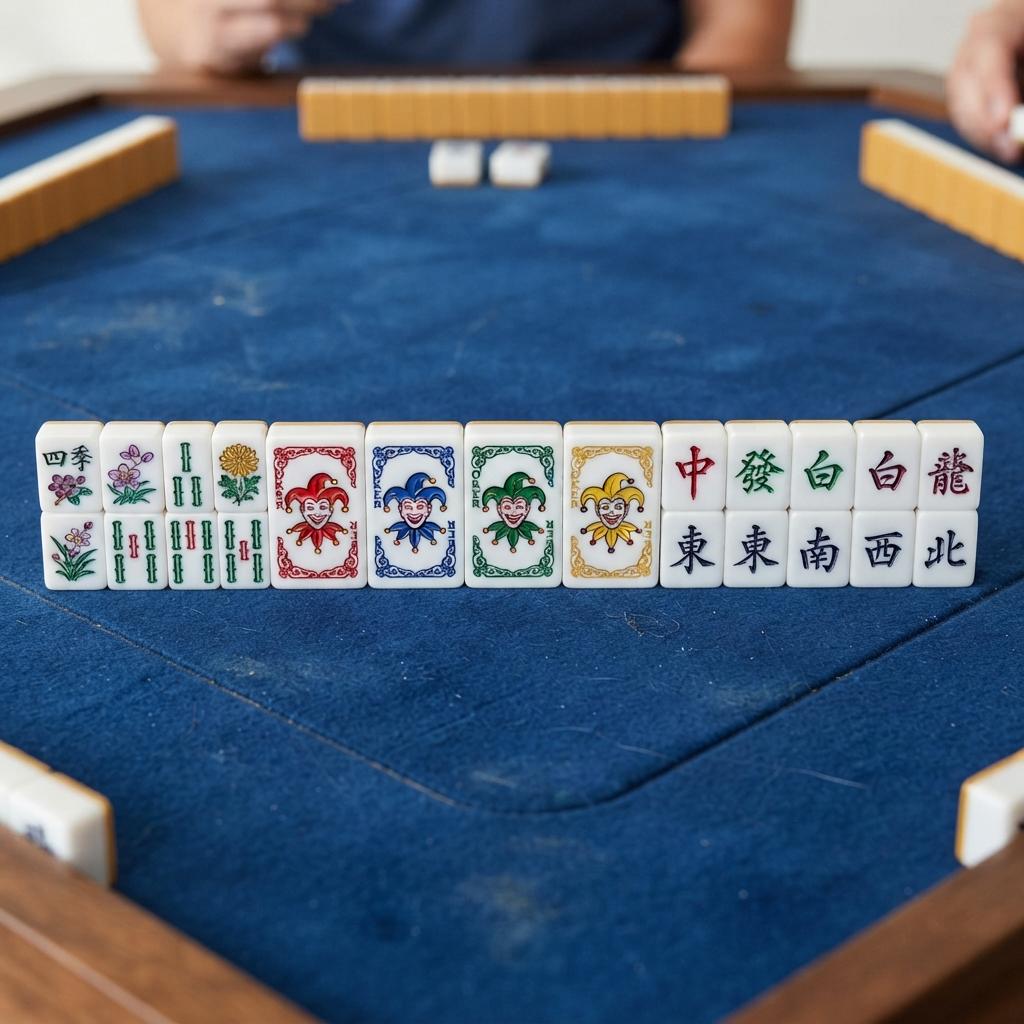
| Joker and blank count | American play needs eight jokers in play | Count the jokers and blanks before the first game |
| Mat colour and surface | Tile edge visibility and glare | Place a tile on the mat and look from across the table |
Readable mahjong tiles pass this list in a dim room, not just under a shop light. If a supplier cannot answer the dimension and joker questions in writing, the photos are doing the selling rather than the specification.
Common mistakes when buying for older players
The most frequent mistakes buyers make with mahjong tiles for older players are about trade-offs, not about budget.
- Choosing mini or travel size for weight. A smaller tile is lighter to carry and harder to read, which trades a one-off inconvenience for a permanent one.
- Assuming bright equals readable. Contrast, stroke width and plain backgrounds matter more than colour count.
- Ignoring the mat. The tile face is only half the contrast equation; the surface it sits on is the other half.
- Buying glossy white on a white table. The tile edge vanishes, and players start patting the table to find pieces.
- Not checking the joker count. An American group cannot play NMJL rules with a 144-tile set that has no jokers at all; see our breakdown of tile counts by rule set.
Mahjong sets and mats from our workshop
Our pink-back American Mahjong tile set is built around a smooth white playing face with a glossy pink back, rounded corners and printed multicolour artwork. It includes Characters, Bamboos, Dots, Winds, Dragons, Flowers, Seasons and Joker tiles, and selected tiles carry Arabic numbers and English wind indicators, which shortens the time a newer or low-vision player spends decoding a symbol. Because the face is white and the back is pink, the tile is also easy to locate against a darker mat.
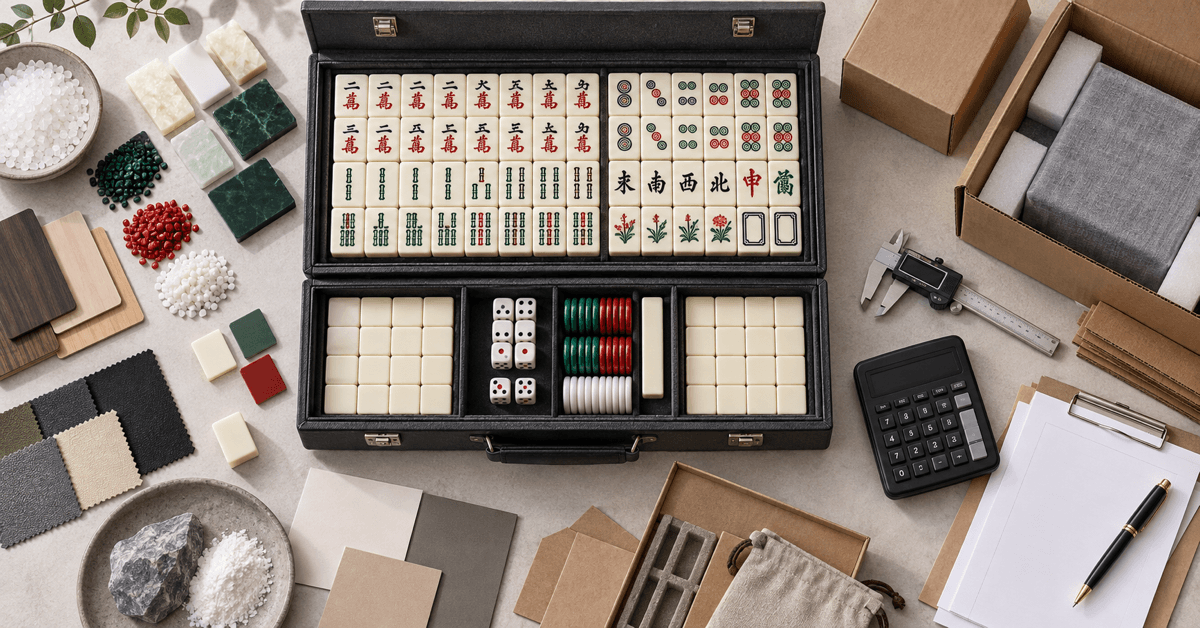
Tile quantity, dimensions, accessories and packaging are configured per order rather than fixed by the box, so a buyer sourcing mahjong tiles for seniors can specify the format, finish and contrasts for that audience instead of accepting a default.
The companion blue Mahjong gaming mat uses a soft playing surface with a defined border and stitched edges. It reduces tile impact noise, helps stop tiles sliding on polished tables, and protects the tabletop. Custom dimensions, colours, printed patterns and logo printing are available for club and retail programmes.
We have more than 20 years of experience in Mahjong products and supply brands, wholesalers, retailers and e-commerce sellers. If you are planning a set for an older audience, contact us with the tile format, market and quantity you have in mind.
Frequently asked questions
What size Mahjong tiles are best for seniors?
There is no single number, but a larger face and a thicker body are easier to read and lift than a compact tile. Ask for the exact face width and thickness in millimetres and compare two formats in the same room light before deciding.
Are mahjong tiles for seniors different from standard tiles?
Not structurally. They are the same game pieces in a larger, thicker format, often with simpler contrast and clearer symbols. The difference is in specification and print design rather than in the rules.
Do large Mahjong tiles make the game harder to set up?
They make the wall longer and taller, not more complex. A 144-tile wall is 18 pairs per side whatever the tile size; larger tiles simply occupy more table space, so check the table and mat dimensions.
Are high contrast Mahjong tiles a real product category?
Not as a standard category. Contrast comes from design decisions: dark symbols on a plain white face, a mat that differs from the tile back, and a finish that does not reflect the room light back at the player.
Is acrylic or melamine better for older players?
Both work. Acrylic has a glossier, glass-like surface that shows fingerprints and glare; melamine is harder and more scratch-resistant, which is why many club sets use it. A satin or matte finish matters more than the material name.
How many tiles does each player handle during a game?
Each player holds 13 tiles and the dealer holds 14, so a rack that comfortably holds 14 tiles at the chosen format avoids overhang and tipping.
How many jokers should the set include?
American Mah Jongg uses eight jokers in play, and many retail sets include ten with two kept as spares. A traditional 144-tile set has no jokers, which is the first thing to confirm if the group plays American rules.
Conclusion
The best mahjong tiles for seniors are not simply the biggest ones. They are the tiles with a large plain face, dark symbols that hold their edge at arm's length, a thick body with rounded corners, and a mat that separates the pieces from the table. Check those four things in person or in a clear photo at table distance, confirm the joker count for the rule set you play, and the rest of the specification becomes much easier to judge.
If you are sourcing a set for a club, a care home or a retail range aimed at older players, send us your requirements and we will match the tile format and accessories to the way the set will actually be used.