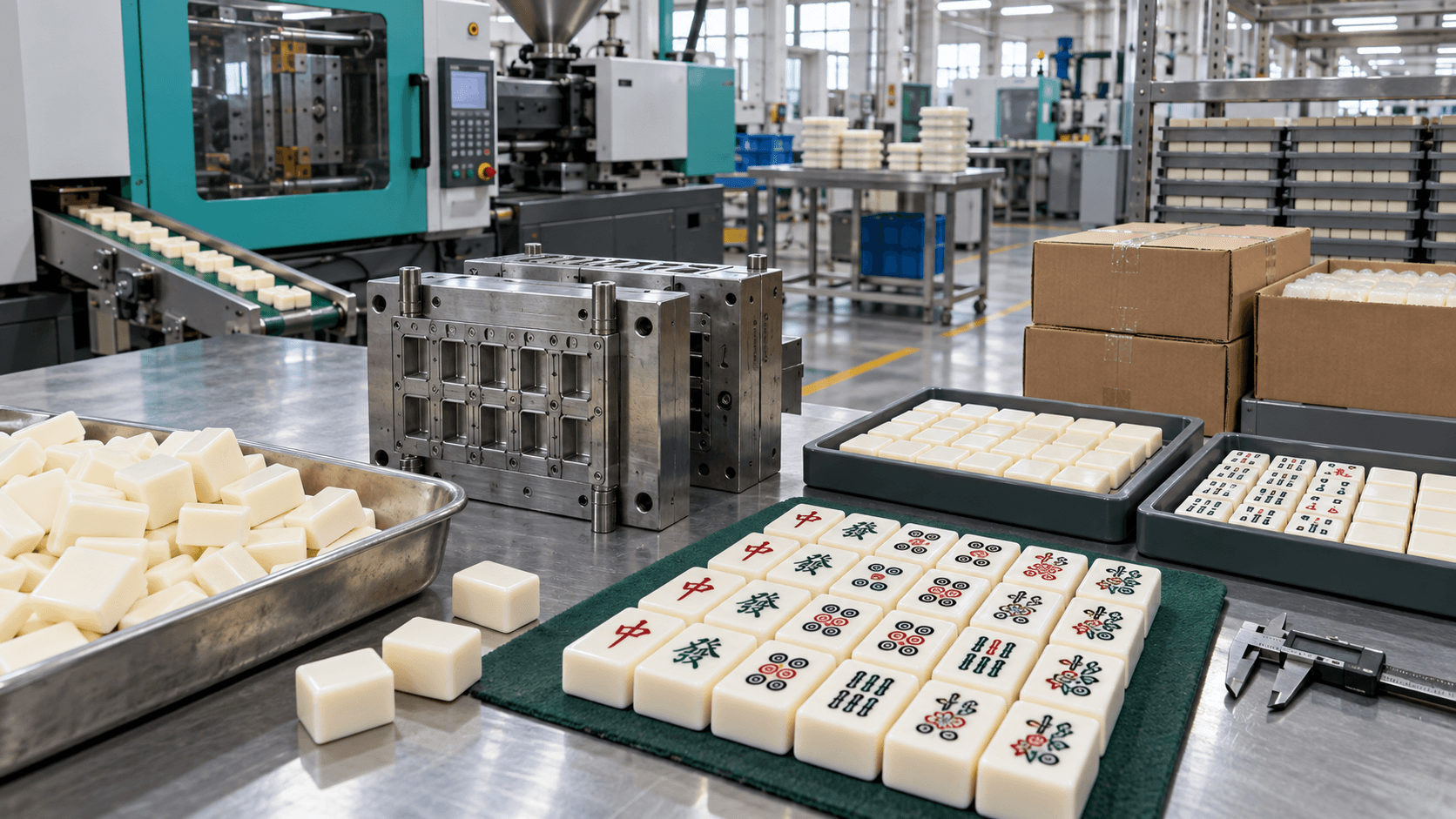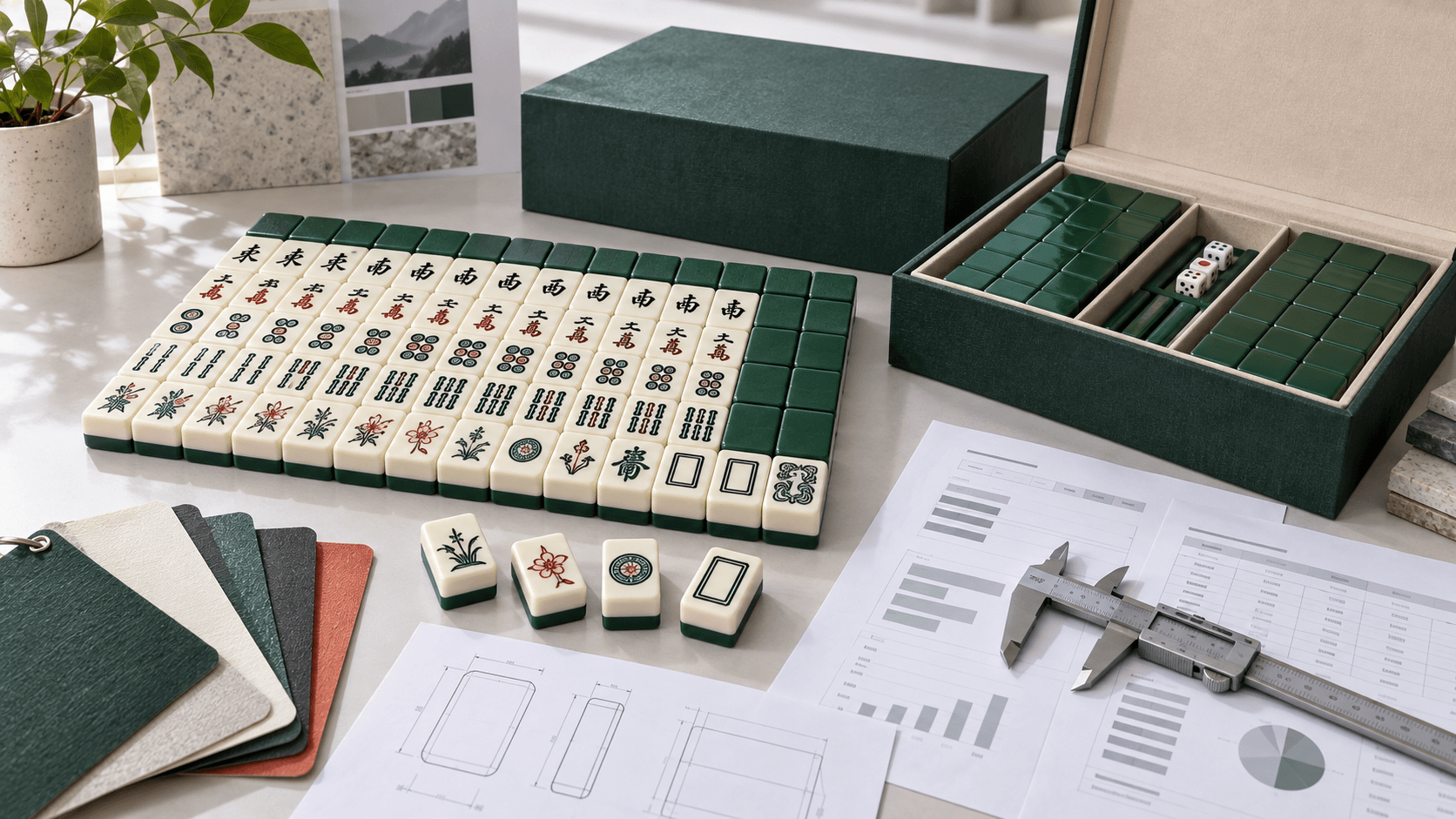
A custom mahjong set MOQ is not determined by one universal factory rule. It is the result of several minimums meeting in one project: tile construction, custom color preparation, artwork processes, molds, printed packaging, accessories, and the number of versions being produced. The useful question is not simply, "What is your lowest quantity?" It is, "Which part of my design is setting the minimum, and what can change without weakening the product?"
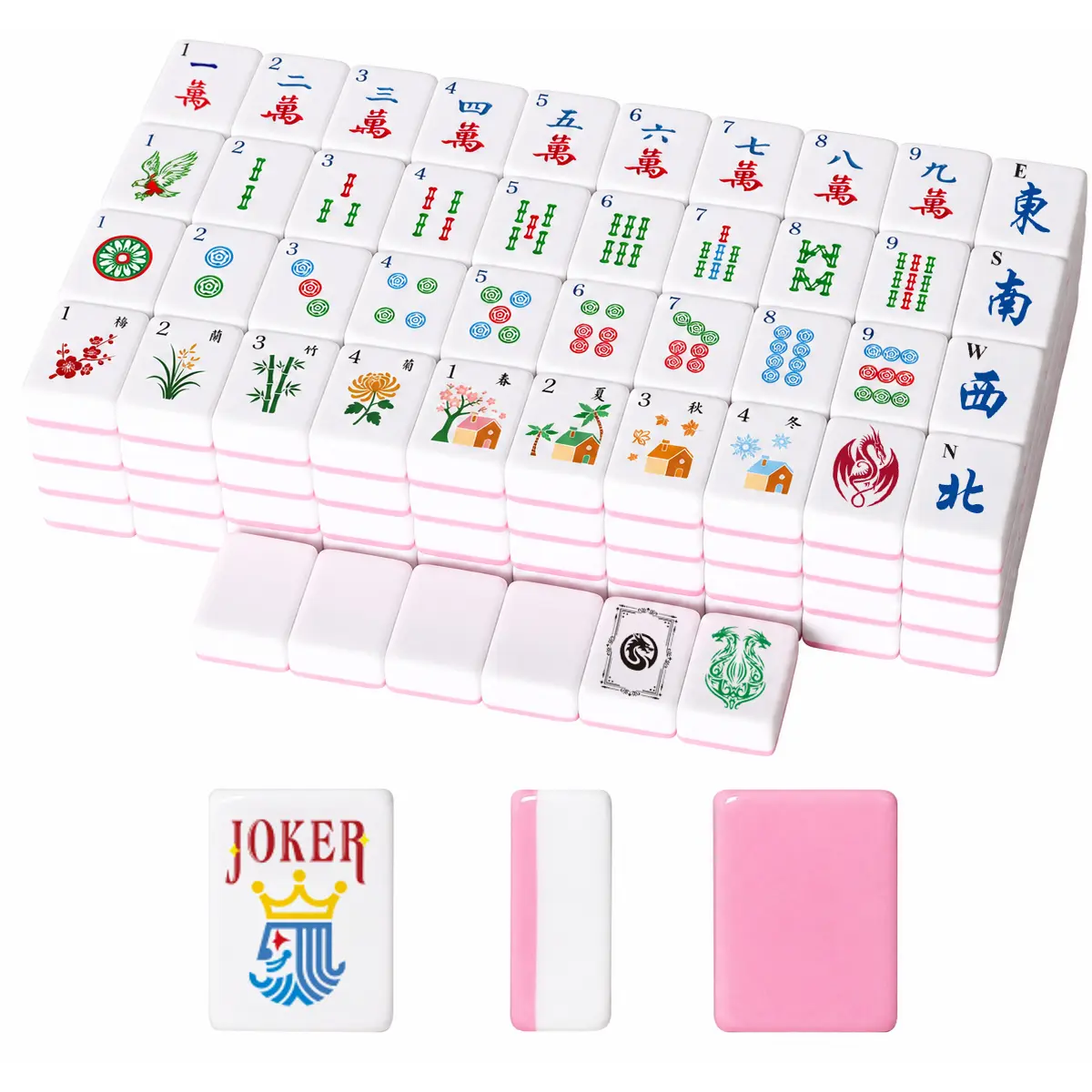
MOQ is a stack of production decisions
Consider a set with custom tile faces, two back colors, four rack colors, a printed rulebook, a rigid gift box, and a fabric bag. A buyer may think of this as one product. Production sees several material purchases and processes. Each can have an efficient batch size, setup requirement, or supplier threshold.
That is why two products that look equally "custom" can produce very different commercial terms. Adding a logo to an established structure may preserve more of an existing process. A new mold, exclusive material color, small print run, and five packaging languages create a different workload even if the final item is still called a Mahjong set.
Find the MOQ driver with a traffic-light review
| Design choice | Likely complexity | Question for the quotation |
|---|---|---|
| Existing tile format with approved artwork change | Lower | Which standard elements remain unchanged? |
| Custom logo, label, or insert | Lower to medium | Is the threshold per printed item or total order? |
| Exclusive color or decorative acrylic effect | Medium | What material preparation or color batch drives the minimum? |
| Several artwork or language versions | Medium to high | Which process resets for each version? |
| New mold or structural change | Higher | What tooling, validation, and production assumptions apply? |
| Fully custom box, insert, and accessories | Higher | Which component has the highest separate threshold? |
This is a discussion tool, not a promise of quantity. The actual threshold depends on the reviewed specification, current process, suppliers, and schedule. ABC Mahjong states that order requirements are confirmed project by project after the product, tooling, artwork, packaging, quantity, and production plan are reviewed.
Six places where the minimum can hide
1. The tile body
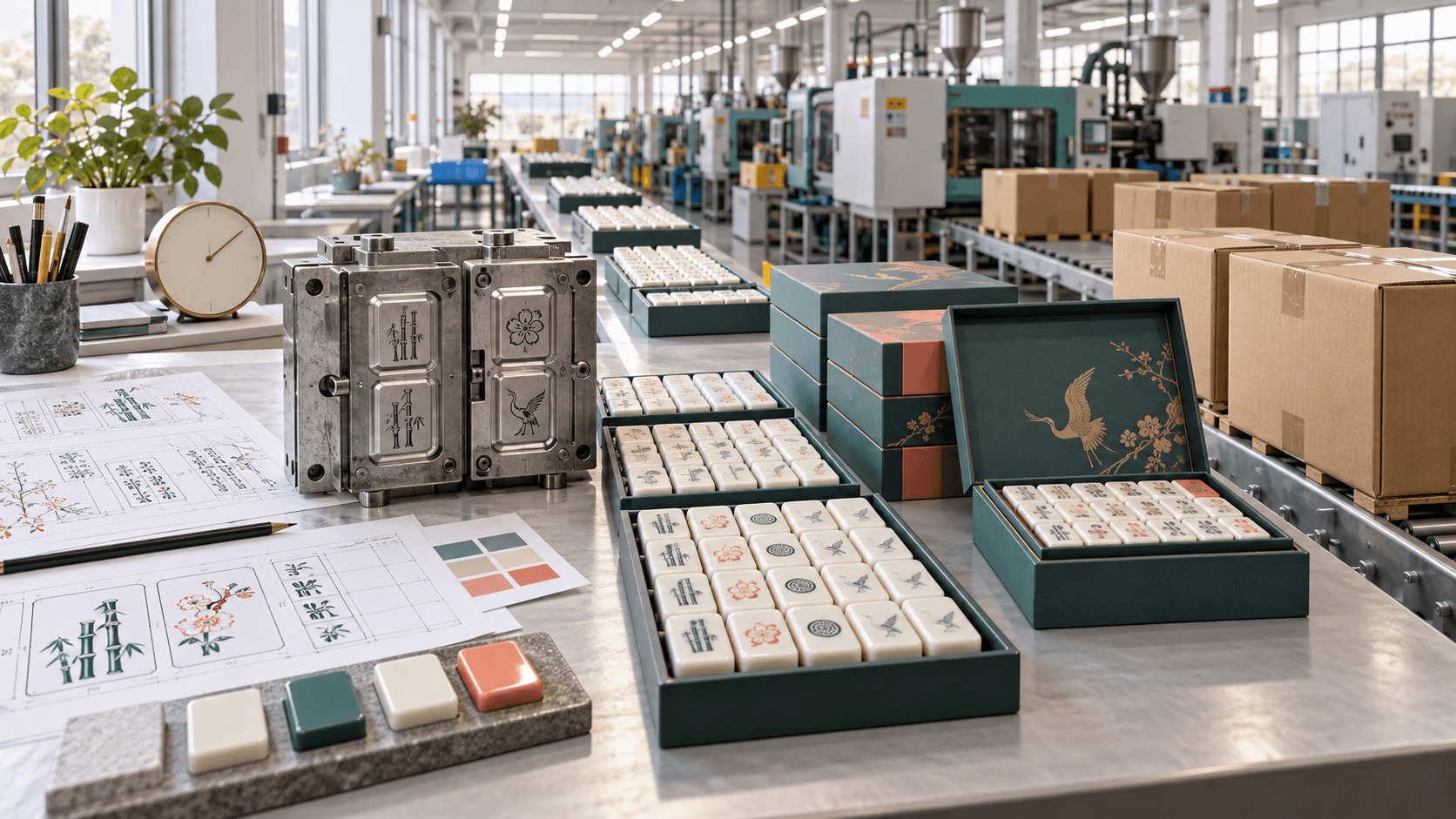
Existing dimensions and construction may use an established process. A new size, edge profile, layered structure, or mold creates engineering and setup work. Ask whether the proposal uses a current format or requires exclusive tooling. The answer affects more than quantity; it can change sampling, rack fit, insert design, and replacement planning.
2. Material and color preparation
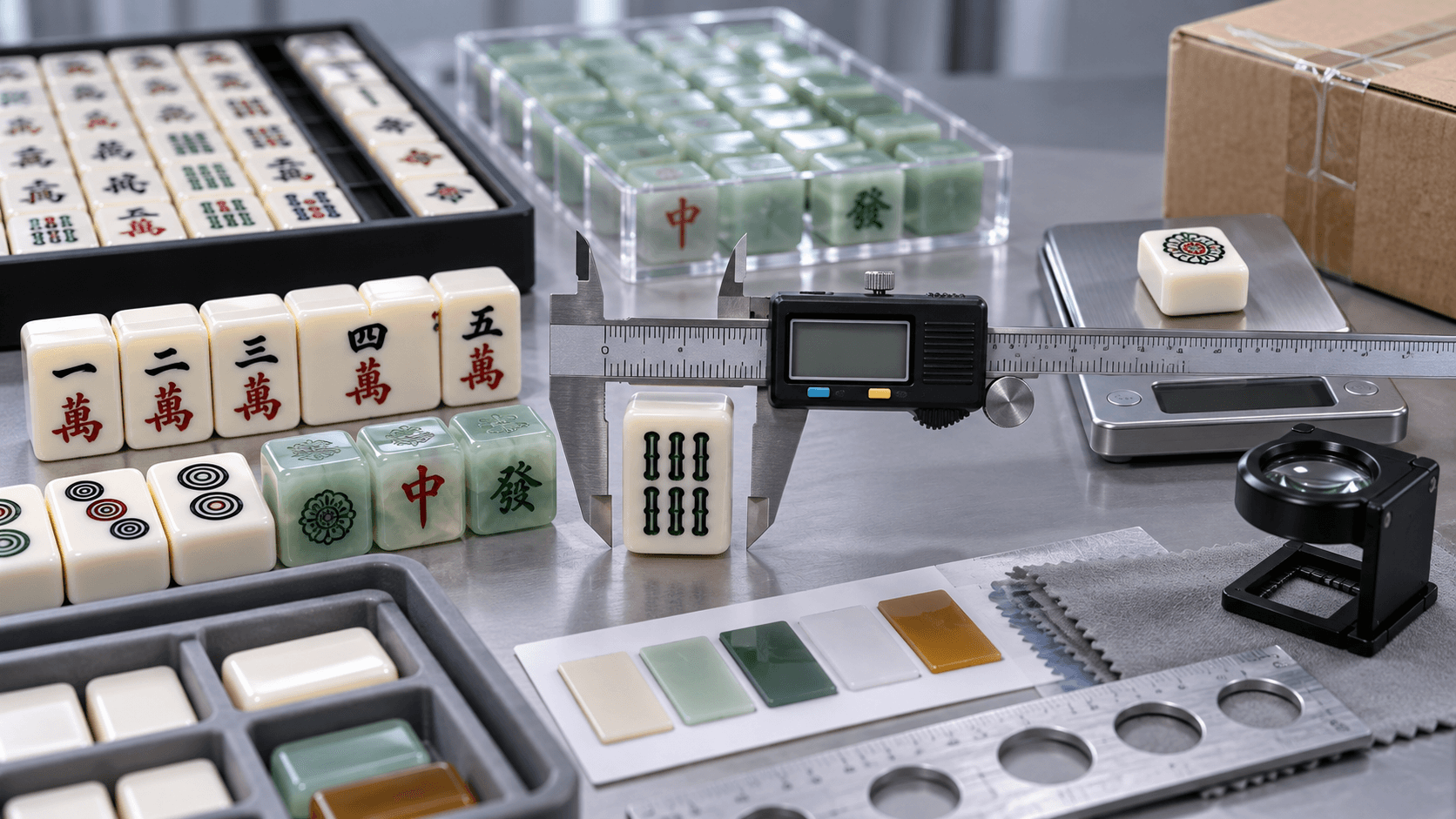
A stock material color can be available on different terms from a specially prepared color or decorative effect. If two colorways are requested, ask whether the minimum applies to the combined order or separately to each color. A buyer can otherwise approve an overall quantity while accidentally creating two undersized material batches.
3. Artwork process
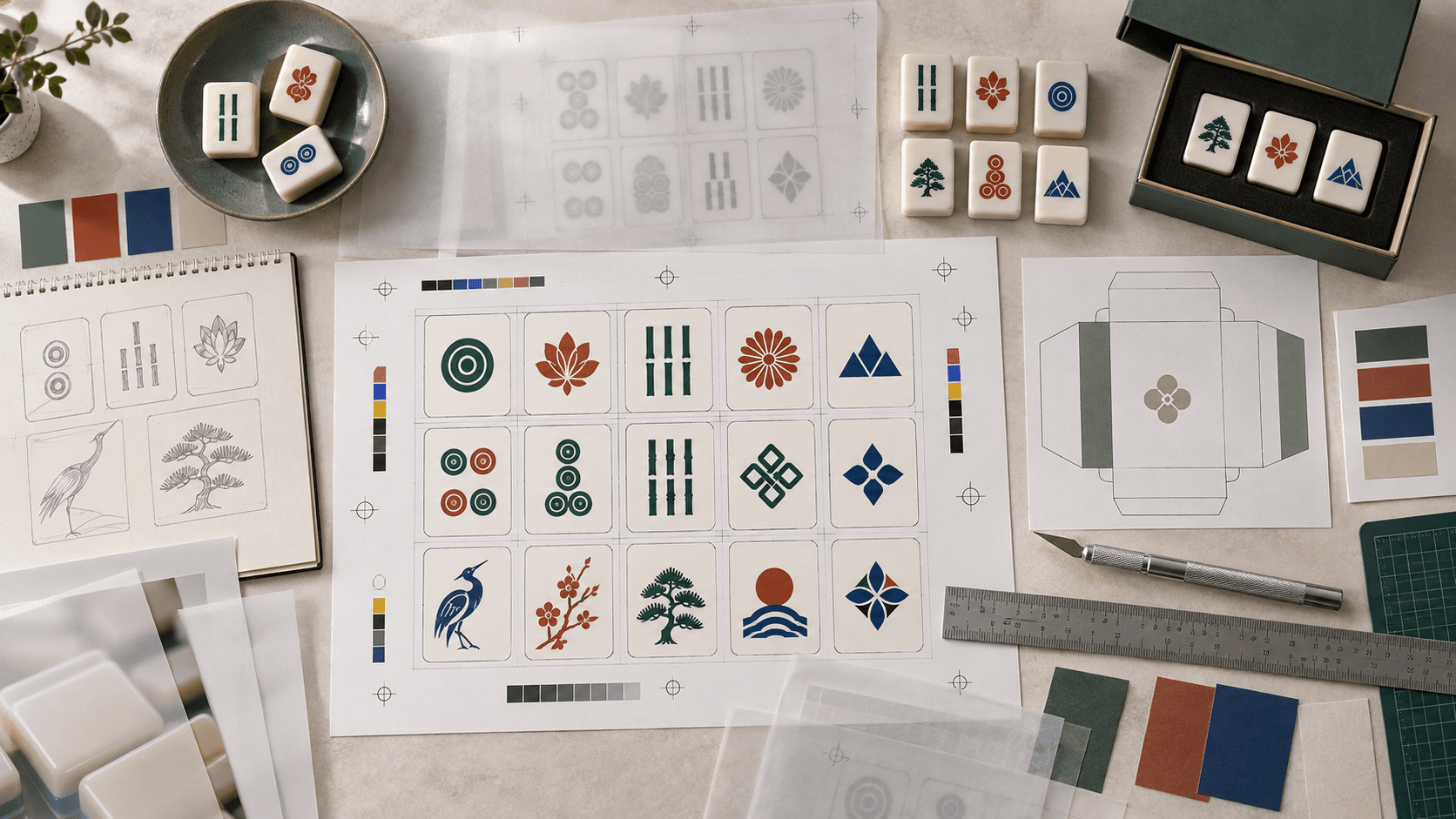
Printing, engraving, color filling, layering, and other decoration methods require different preparation. Count the number of unique faces and versions, not only the number of finished sets. A second language, alternate joker, or event logo may introduce another setup even when most art remains the same.
4. Retail packaging
Boxes, sleeves, labels, inserts, manuals, and barcodes may come from separate production runs. Packaging can become the controlling minimum, particularly when a buyer divides one product into several languages or seasonal designs. Ask for each packaging threshold on its own line.
5. Matching accessories
Racks, pushers, dice, mats, cases, and small parts may have standard choices or custom colors and logos. The set-level order can be feasible while one custom accessory remains inefficient. A coordinated collection does not always require every component to be newly tooled or custom colored.
6. SKU fragmentation
Five hundred sets in one design are not operationally identical to five hundred sets divided into ten designs. Each SKU needs artwork control, labels, packing, counts, and inventory handling. Ask which elements can be shared across variants and which cause a separate production change.
Three buyer briefs, three different outcomes
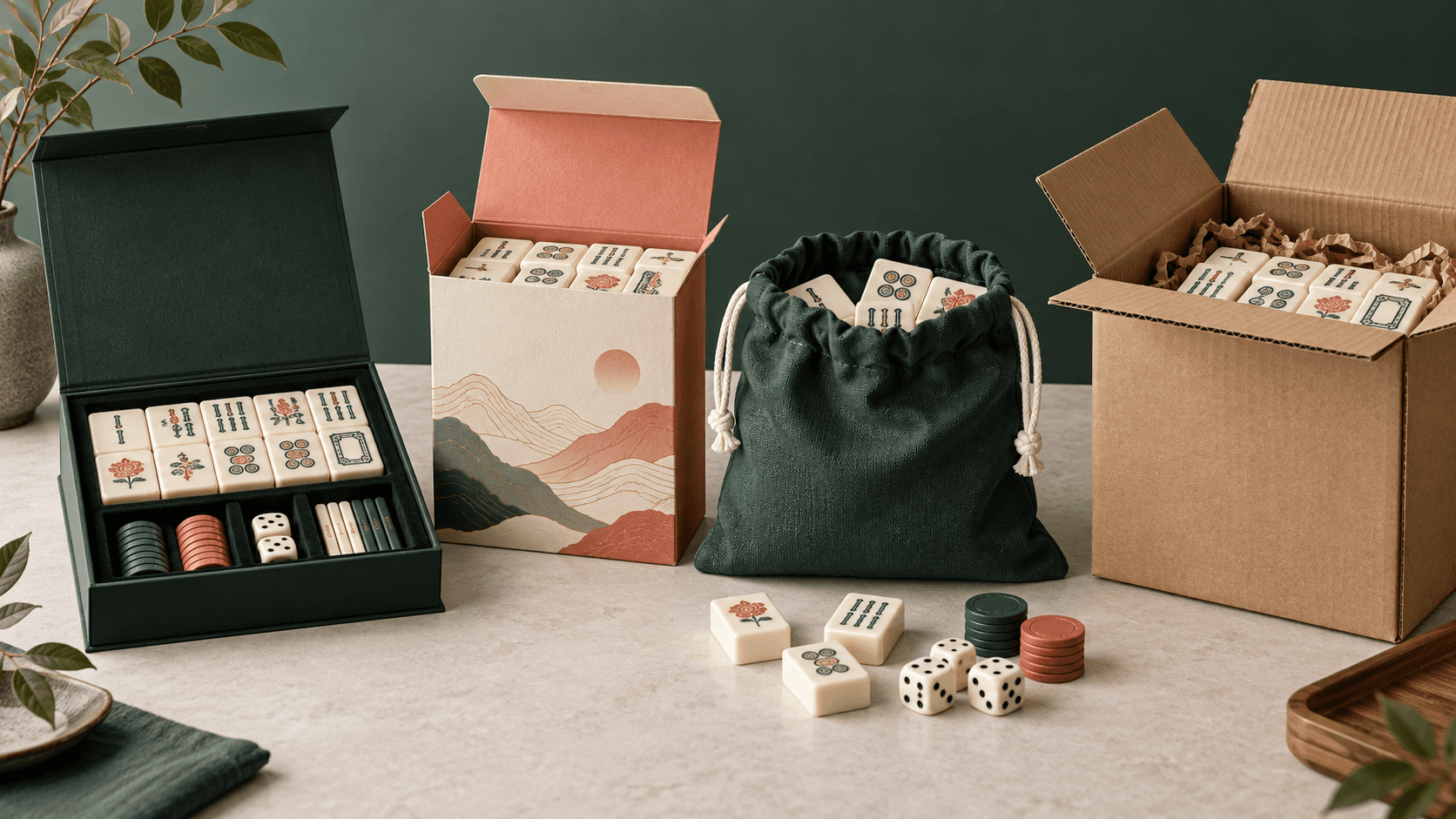
The pilot brand: The buyer wants to test demand with one visual identity. It may keep an existing tile format, choose one color, use a standard case, and concentrate custom work in the faces, label, and insert. The brand still looks intentional, while fewer processes set independent thresholds.
The retail collection: The buyer wants three colorways for the same customer. A shared box structure and common rulebook may reduce fragmentation, while a sleeve or label distinguishes each SKU. The question is whether the tile colors can be produced on suitable terms and whether the shared pack remains truthful for every version.
The licensed event product: The buyer needs an event logo, special date, recipient card, and fixed delivery window. The print items may be unique even if the physical set is established. Artwork approval and rights clearance can become more urgent than reducing the numerical minimum.
What a custom mahjong set MOQ does not tell you
A low threshold is not the same as a low-risk order. It says nothing by itself about tooling charges, sample expense, packaging setup, freight, inspection, payment terms, or the cost of splitting stock across many slow-moving SKUs. It also does not tell you whether the design can be replenished consistently.
Compare the total commercial structure:
- What exactly is included in one finished set?
- Which charges are one-time and which repeat?
- Does the price assume approved standard components?
- How are samples, tooling, artwork preparation, and packaging handled?
- What are the unit, inner-pack, and master-carton quantities?
- Which trade term and named place are used?
- Who arranges inspection, transport, insurance, customs, and local delivery?
The International Chamber of Commerce explains that Incoterms rules allocate important delivery responsibilities, costs, and risks between buyers and sellers. Its official Incoterms 2020 overview is a useful reference. A quotation should identify the agreed rule and named place rather than using a vague phrase such as "shipping included." Incoterms do not replace the complete sales contract, product specification, or payment agreement.
Use a complexity budget before asking for a concession
If the first-order quantity is constrained, decide where customization creates the most customer value. Give each custom feature one of three labels:
- Essential: without it, the product does not express the brand or serve the market.
- Helpful: it improves the offer but can use an established option for the first run.
- Later: it belongs in a follow-up release after demand is clearer.
A signature tile face and strong package label may matter more than an exclusive mold for a pilot. Another brand may rely on transparent construction and a custom case as the core idea. There is no universal correct answer. The point is to spend complexity deliberately.
Five practical ways to simplify a first order
- Reduce colorways: launch the strongest palette rather than dividing volume equally among untested options.
- Share structures: use one tile size, insert, box structure, or rulebook format across compatible SKUs.
- Use labels or sleeves intelligently: differentiate a product without creating a completely separate box construction, provided all claims remain accurate.
- Customize the visible priorities: keep less important accessories standard while making the tile artwork and customer-facing pack distinctive.
- Plan the second order now: record colors, materials, artwork, and packaging so a successful SKU can be replenished rather than reinvented.
These are possibilities to discuss, not guaranteed ways to reduce an order. A change that simplifies one process may complicate another.
Send one RFQ that can be answered
A vague request for "best price and lowest MOQ" forces the supplier to assume the product. A useful request includes the target market, buyer type, game format, tile count, preferred dimensions, material direction, face and back artwork, colorways, accessories, packaging, quantity by SKU, destination, target date, and sample expectations.
Mark uncertain items. For example: "Tile size open to an existing format; back color essential; rigid box optional if a durable standard case is available." This gives the factory room to propose a more efficient path without quietly changing the concept.
Read quotations line by line
| Quotation line | Clarify | Watch for |
|---|---|---|
| Finished set | Exact components, count, material, finish, pack | Different scopes presented as comparable prices |
| MOQ | Per design, color, packaging version, or total | A total that hides separate component thresholds |
| One-time work | Tooling, setup, development, ownership, reuse | Charges that reappear without explanation |
| Samples | Purpose, quantity, included features, courier | A visual sample treated as proof of every requirement |
| Delivery basis | Incoterm, named place, freight assumptions | Unit price compared without landed-cost context |
FAQ
Is there one standard minimum for all Mahjong products?
No. The product, materials, tooling, decoration, packaging, variants, accessories, and production schedule can all affect the requirement. Request terms for a defined specification.
Can different colors be combined to meet the minimum?
Sometimes, but not automatically. Ask whether the material or process threshold applies to each color, design, or total order. Obtain the answer in writing.
Does a logo-only project usually need the same quantity as a new mold?
The work is different, so the terms may differ. A logo on an established product may preserve more standard processes, while new tooling adds development and validation. Only a reviewed brief can confirm the quotation.
Can packaging set the minimum even when the tiles do not?
Yes. Printed boxes, inserts, manuals, sleeves, and labels may have their own efficient run sizes. Ask for component-level thresholds.
Should a buyer split the first order among many designs?
Only when the commercial and production logic supports it. Too many SKUs can fragment material, artwork, labeling, and inventory. A focused launch often produces clearer sales information.
What information is needed for an accurate quotation?
Share product format, count, dimensions, materials, artwork, colors, accessories, packaging, quantity per SKU, target market, destination, required date, and which details remain flexible.
How should buyers compare two MOQ offers?
Compare the same product scope, quality references, one-time charges, samples, packaging, trade term, payment terms, inspection, and delivery assumptions. Quantity alone is not a complete offer.
Ask which decision is driving the number
ABC Mahjong provides OEM/ODM support for tiles, racks, pushers, cases, packaging, private label collections, and related accessories. Review the customization workflow, study the available product range, and learn how the company handles sampling and production. Then send a structured brief through the contact page. The team can identify the real driver behind your custom mahjong set MOQ and provide project-specific terms instead of a number detached from the design.