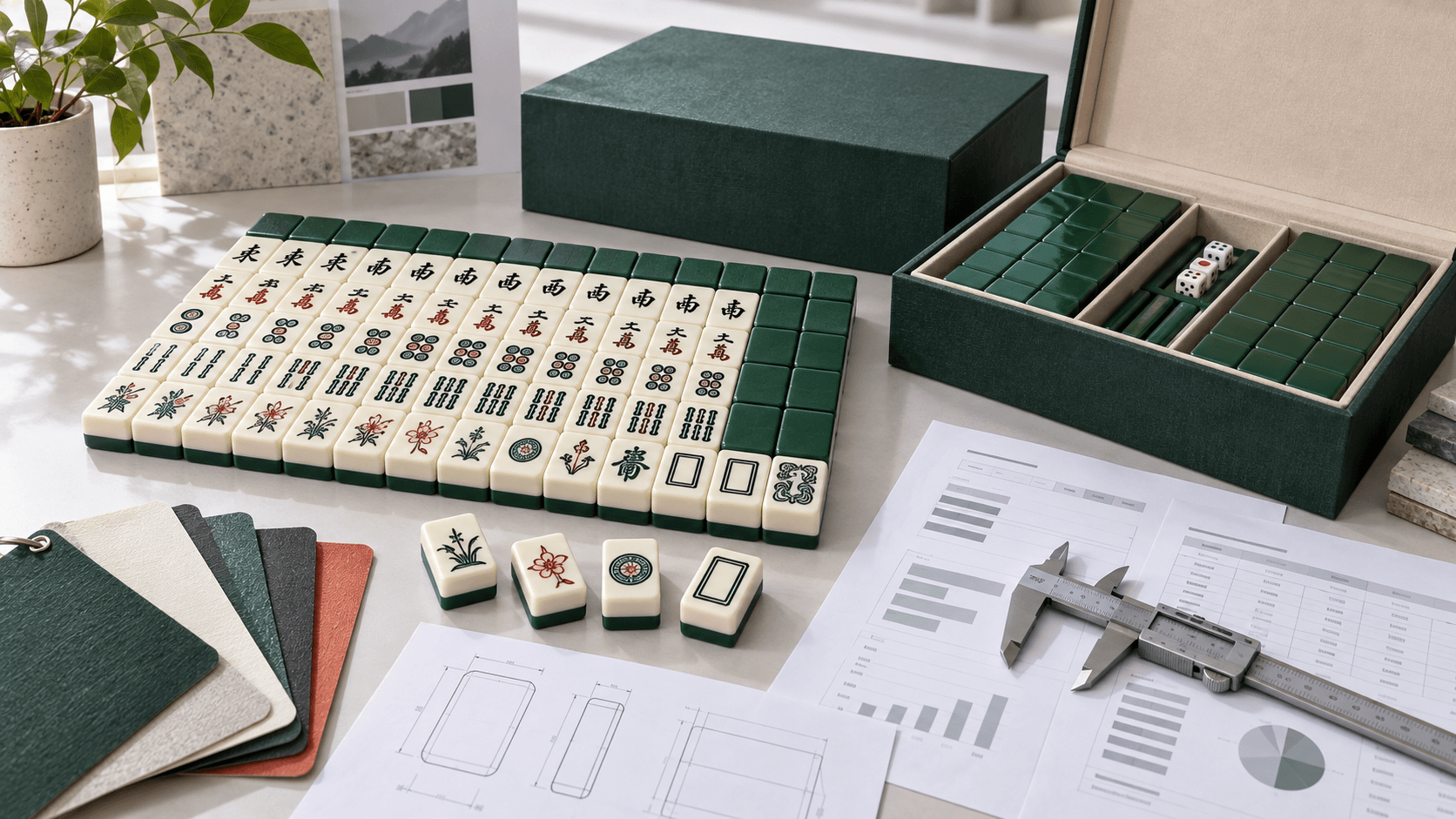

Why a Mahjong Dice Manufacturer Is Not Just a Dice Supplier
When buyers search for a Mahjong Dice manufacturer, they are usually not looking for novelty plastic cubes. They are looking for a partner who can make small, repeatable components that feel right in the hand, read clearly on the table, and fit the overall quality level of a mahjong set or gaming accessory line. That sounds simple until the first sample arrives and the corners feel too sharp, the pips are hard to read, or the finish looks good in photos but less convincing under retail lighting.
Mahjong dice sit in an odd middle ground. They are small, but they still affect the user’s perception of the entire set. In a home game, that may mean comfort and legibility. In a gift box, it may mean visual appeal and consistency. For sourcing teams, it usually means a basic question: which factory can deliver dice that are visually clean, dimensionally uniform, and suitable for the intended market without forcing the buyer into expensive over-specification?
What the Visible Product Details Suggest
The dice described here appear to be standard six-sided game dice with a white glossy body and colored pips. The shape is a rounded-corner cube rather than a sharp-edged block, which is often preferred for handling and for reducing the hard, brittle look that some buyers associate with low-end dice. The dot faces appear high-contrast, with red and blue pips that are easy to distinguish at a glance.
That visual clarity matters. In a mahjong context, dice are often rolled quickly and read across a table. A finish that looks attractive in a product image is useful, but legibility is what makes the set practical. Rounded edges also help create a softer tactile feel, though the buyer should remember that appearance alone does not prove balance accuracy or long-term wear resistance.
The likely manufacturing route is injection molding or molded resin with decoration applied afterward, but that remains an informed guess rather than a confirmed process. Buyers should treat the image as a cue for finish and geometry, not as proof of material composition or internal construction.
What Buyers Should Ask Before Ordering
A serious supplier conversation should move beyond “Can you make dice?” and into the details that affect consistency. The first question is simple: what exact size are you quoting? Small changes in edge length can change the feel of the dice, the visibility of the pips, and how the product sits alongside tiles, cups, and other mahjong accessories. If the size matters to your packaging, ask for a dimensional drawing or a sample before approving mass production.
Next, ask about material and surface finish in plain language. If the dice are plastic, what type of plastic is used? If the product is a resin-style item, how is the surface finished and how are the pips added? A buyer does not need every technical detail on day one, but it is worth knowing whether the decoration is printed, painted, or inlaid, because wear behavior is very different across those methods.
Then ask about consistency across a batch. Uniform cube shape and clean edges are visible quality markers, but the real value is in repeatability. A mahjong dice manufacturer should be able to explain how they control appearance from sample to production, how they inspect face marking, and what happens if a small percentage of pieces fail visual checks.
How the Product Fits Different Buying Scenarios
Mahjong set suppliers
For full mahjong sets, dice are usually a supporting item rather than the hero product, but they still need to match the broader presentation. A set with polished tiles and a rough-looking die can feel mismatched. Buyers in this category often care most about reliable finish, stable color, and the ability to keep the dice visually consistent across larger order quantities.
Board game and teaching products
For board games, educational kits, and classroom use, readability becomes the main issue. High-contrast pips are helpful because they reduce ambiguity for children, older players, and anyone who needs to identify the face quickly. In teaching tools, the dice may also be handled more roughly, so rounded corners and a durable surface are practical rather than decorative choices.
Promotional and novelty sets
In promotional packaging, the buyer may care less about technical gaming purity and more about presentation. A glossy white body can work well in a branded box or gift set, especially if the pips offer a color accent. The caution here is straightforward: novelty should not make the product look flimsy. Even a gift item still needs to feel intentional, not disposable.
Selection Criteria That Actually Matter
There are several quiet details that separate a workable supplier from a risky one. First is edge quality. Rounded edges are more comfortable and often more attractive, but they must still be even from piece to piece. Second is face marking clarity. The pips should be placed cleanly and read consistently at normal viewing distance. Third is surface consistency. A glossy finish can look premium, but only if it is even and free from obvious blemishes, haze, or tool marks.
Another point that buyers sometimes overlook is packaging fit. Dice can chip, scuff, or collect surface marks if they move around too much in transit. If the dice are part of a gift or retail set, ask the factory how they intend to protect the finish during shipping. That may sound minor, but it is often the difference between a sample that passes and a shipment that disappoints.
Balance is harder to judge from a photo, and it should not be assumed. If true gameplay fairness is important, request the manufacturer’s testing approach or your own third-party verification. For many commercial uses, visual consistency is enough. For others, especially gaming products aimed at serious players, it may not be.
Common Mistakes When Sourcing Dice
The most common mistake is approving based on a single attractive sample. One hand-finished sample can hide the real production spread. A better approach is to review multiple pieces from a production-like sample set and look for variation in color, mark placement, and edge finishing.
Another mistake is focusing too much on pip color and not enough on the body finish. Bright dots help, but if the base material looks uneven or cheap, the overall product still feels low value. Buyers should look at the whole object, not just the face markings.
A third mistake is assuming that all dice are functionally interchangeable. They are not. Dice for a tabletop game, a mahjong accessory pack, and a classroom counting tool may all be six-sided cubes, but they serve different buyers and should be specified differently. A manufacturer that understands those differences will usually ask better questions up front.
Practical Questions to Put on the RFQ
Before you send a request for quotation, it helps to define a few basics in writing: target size, finish preference, pip color preference, expected order quantity, packaging style, and whether you need custom branding or plain stock dice. You do not need a novel; you need enough detail for the supplier to quote responsibly.
Also ask for confirmation on what is not yet known. If you have not fixed material composition, decoration method, or certification needs, say so. A good supplier will help narrow the options instead of pretending every variation is identical. That honesty matters more than a polished sales pitch.
FAQ
Are these dice only for mahjong?
Not necessarily. Standard six-sided dice can also be used in board games, teaching products, party games, and novelty sets. Their role in mahjong is one specific use case.
Do glossy dice always mean better quality?
No. Gloss can improve visual appeal, but quality depends on consistency, finish control, and how well the dice hold up in use.
Should I ask for balance testing?
If fairness matters to your application, yes. If the dice are for decorative or casual use, visual quality may be the priority instead.
Can I judge material from a photo?
Not reliably. A photo can suggest a smooth molded plastic or resin-like finish, but it cannot confirm composition.
What to Do Next
If you are comparing suppliers, start with a clear product brief and ask for samples that reflect real production conditions, not just a display piece. Then compare finish, readability, consistency, and packaging fit side by side. For a mahjong line, the best dice are usually the ones that disappear into the set in a good way: clean, readable, and dependable without drawing attention to themselves.
That is often what a buyer really wants from a Mahjong Dice manufacturer anyway. Not spectacle. Just a small component that arrives on time, looks consistent, and does its job every time it is rolled.