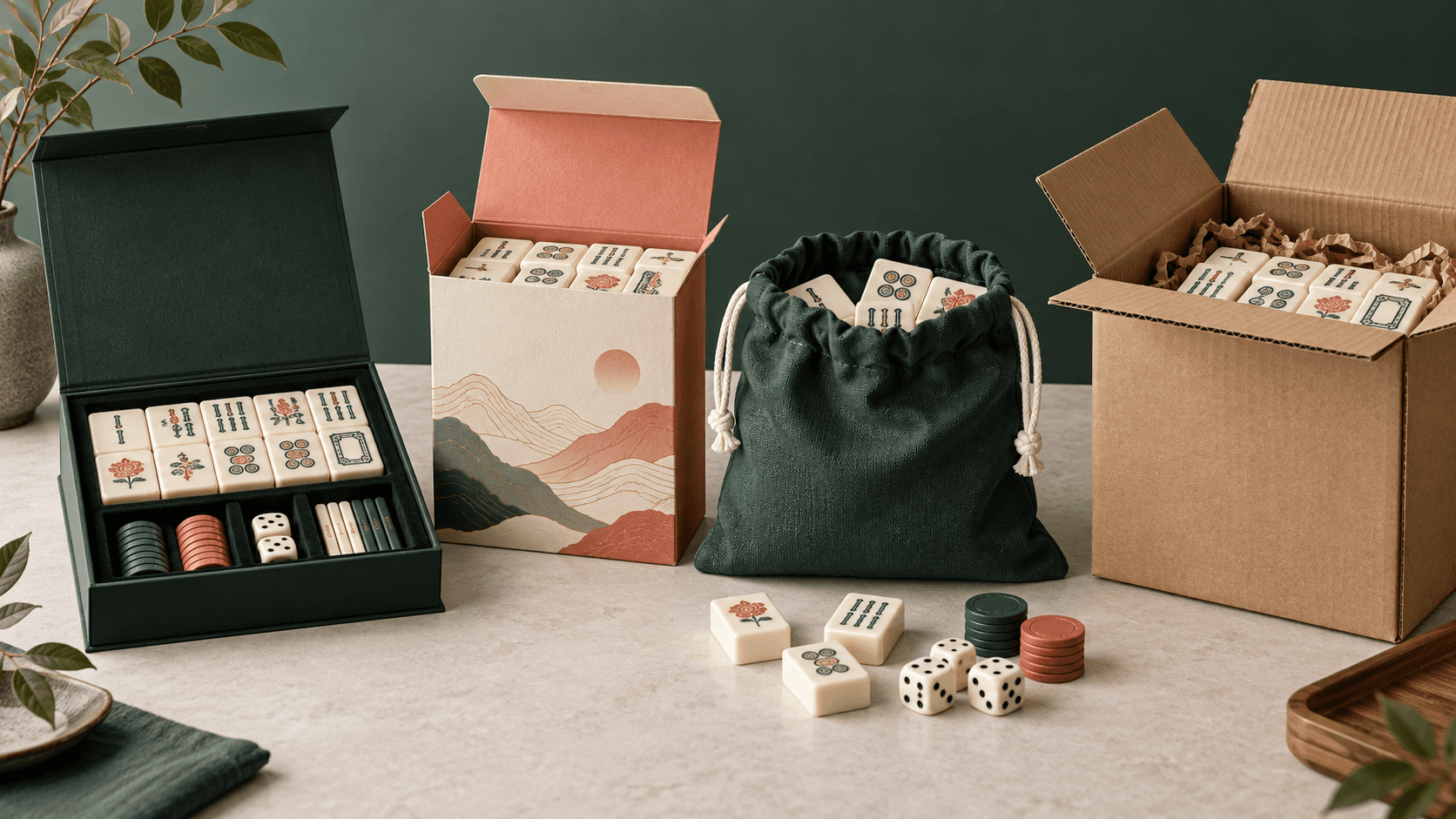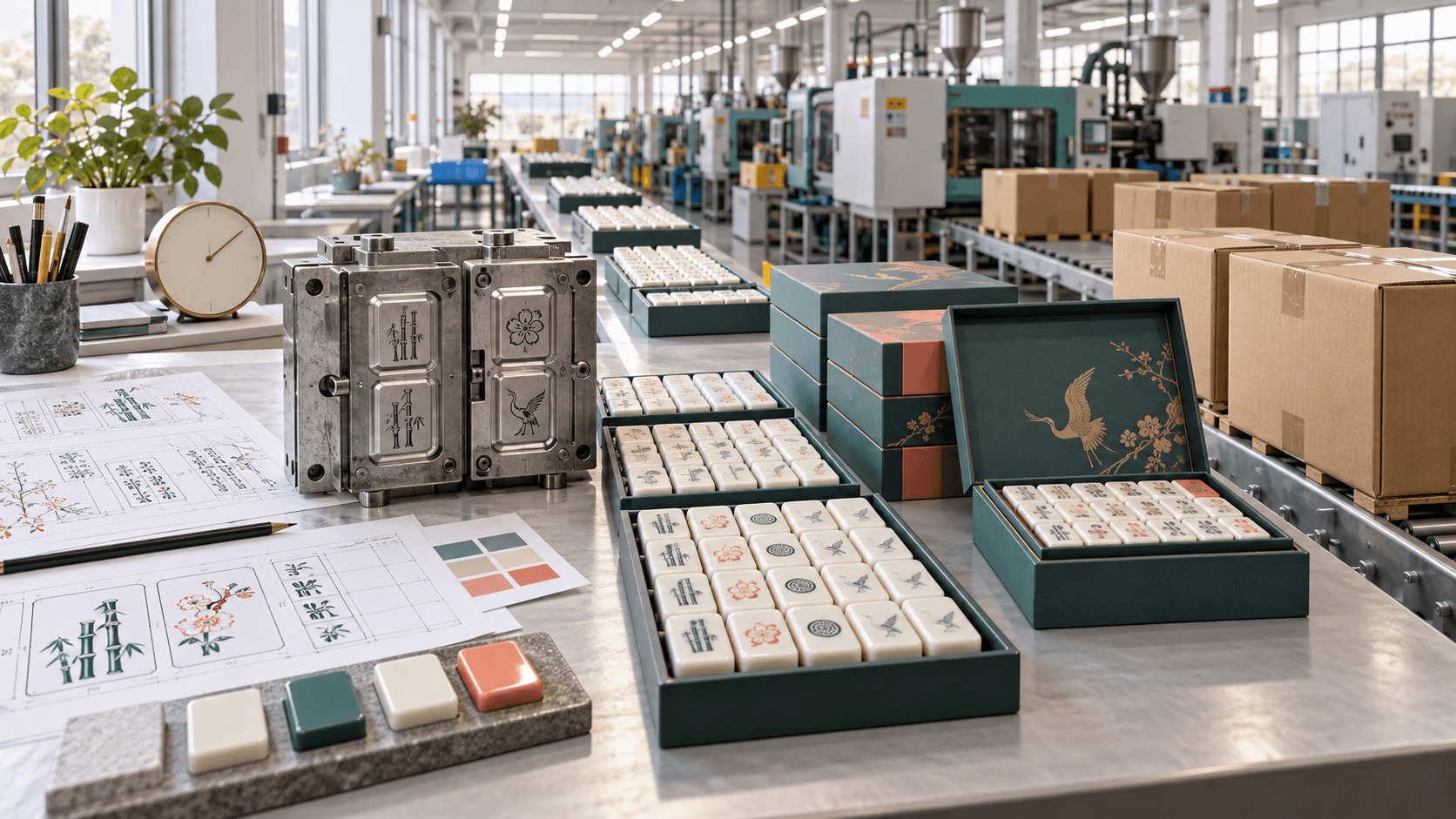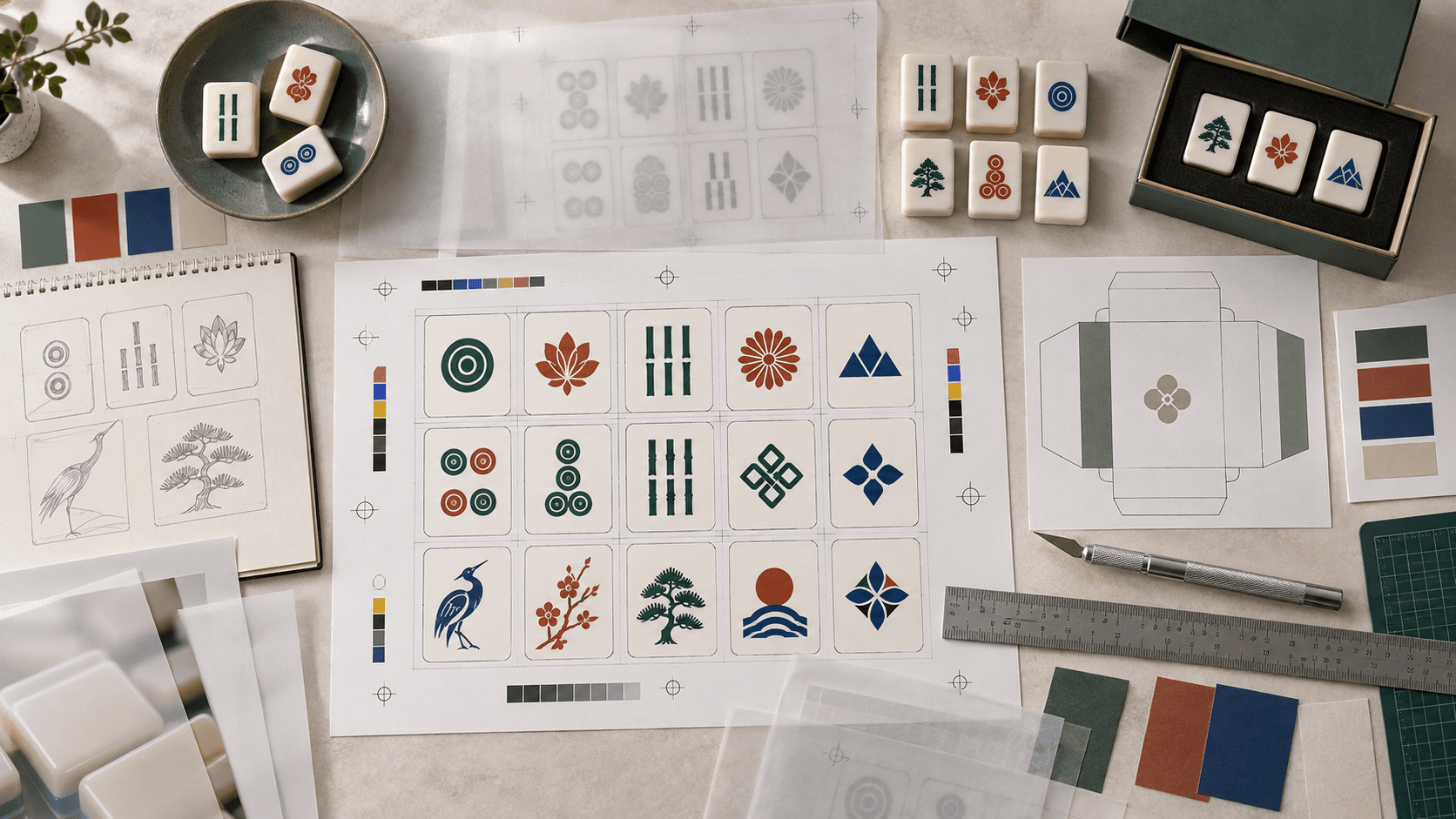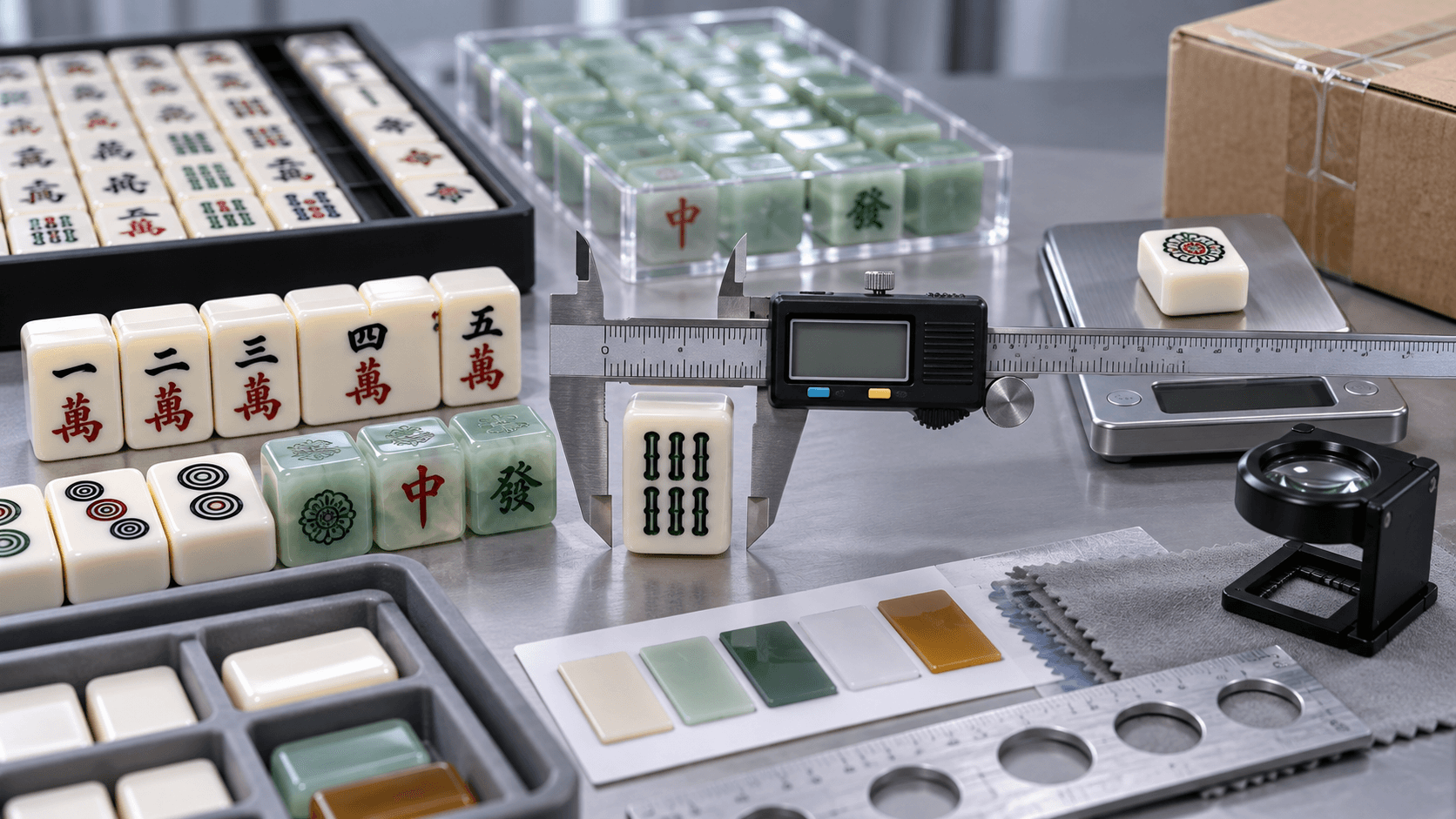

Mahjong sets for ecommerce sellers must survive two journeys at once. The listing has to set an accurate expectation, and the physical product has to travel through storage, picking, parcel handling, unboxing, play, and possible return without creating avoidable confusion or damage.
Moment 1: the shopper sees one image
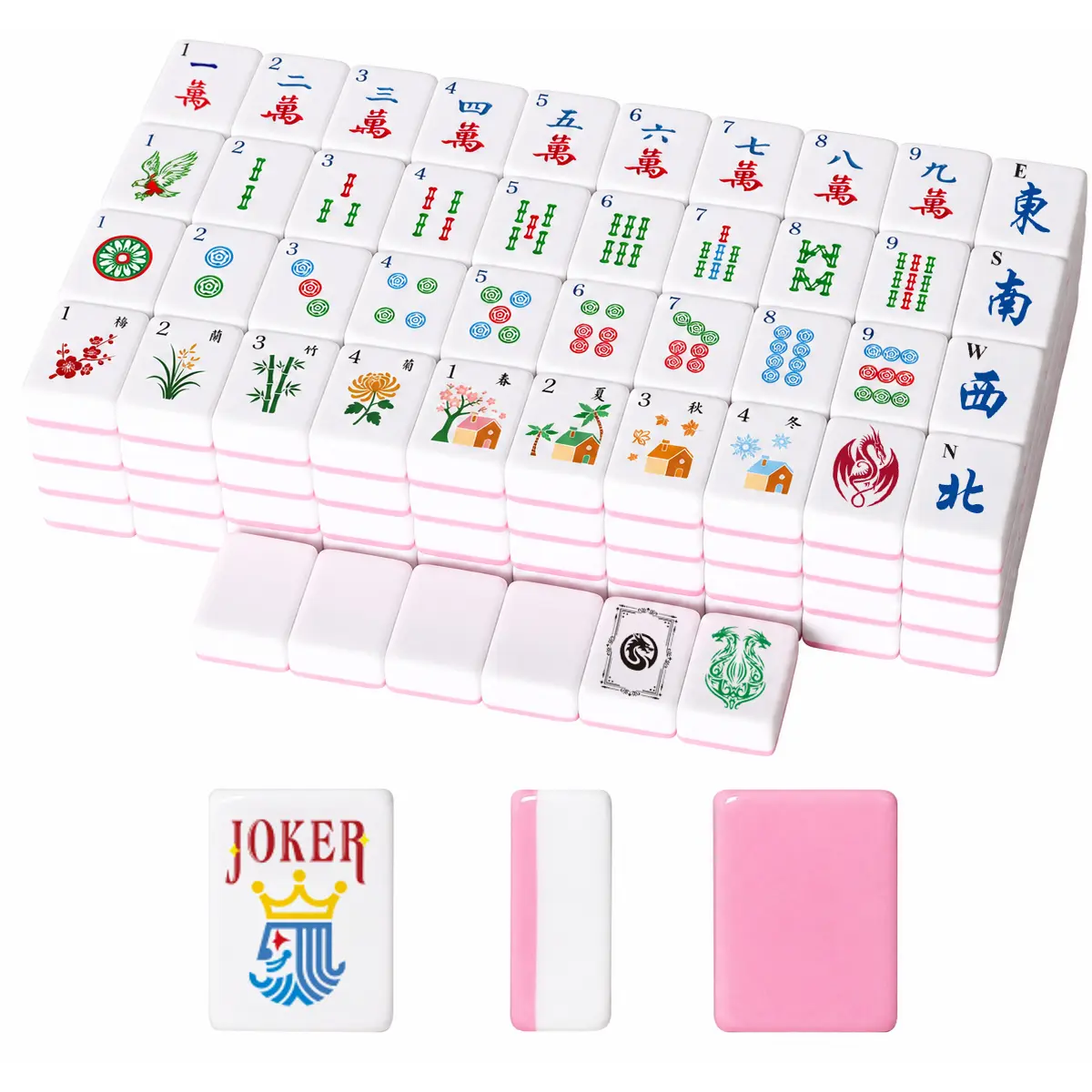
The first image and title should identify the regional format, complete contents, size cue, and central design idea. Do not let a dramatic close-up hide the actual count or accessories. If racks, pushers, a mat, or a case are not included, the page should not imply that they are.
Build a fact sheet before photography. Merchandising, support, the factory, and the package should use the same SKU name, tile count, dimensions, language, accessory list, care notes, and replacement policy.
Moment 2: the picker handles the SKU
Warehouse staff need fast identification. Give each saleable configuration one stable SKU, barcode plan, visible variant cue, and carton marking. Similar boxes with small color names can cause mis-picks even when the customer-facing design looks elegant.
GS1 explains that companies assign identification numbers to trade items and use them within barcode systems. Its barcode implementation guide is a useful starting point; the seller should still confirm the exact marketplace, retailer, and destination requirements.
| Commerce fact | Listing | Physical pack | Operations record |
|---|---|---|---|
| Regional format | Title and key image | Front or back panel | SKU master |
| Tile and accessory count | Contents section | Pack list or insert | Bill of materials |
| Dimensions and weight | Specifications | When required | Item and parcel data |
| Variant | Color or design selector | Visible label cue | Barcode and location |
| Replacement route | Support information | Insert or QR destination | Service inventory map |
Moment 3: the parcel meets the network
A retail box protects presentation; a shipping system protects the sale. Decide whether the set travels inside an over-box, in its own container, or through another defined route. Use the actual product, accessories, insert, retail package, closure, and dunnage in testing.
ISTA distinguishes screening procedures from general simulations of transport hazards and notes that the selected test should match the desired outcome. Buyers can use the ISTA test procedure overview to discuss a suitable plan with a qualified packaging professional or certified lab.
Moment 4: the customer opens the box
Unboxing should confirm the listing quickly. Put the format, component guide, and first action where they are easy to find. A visually quiet card that names each item may prevent more support contacts than a long welcome message.
Test removal and repacking with someone who did not design the insert. Tiles should not spill when a tray lifts. Small dice should not disappear under folds. Racks should not conceal a manual. The customer should understand where everything returns after play.
Moment 5: support receives a message
Plan for “one tile is missing,” “the rack does not fit,” “I expected another format,” and “the box arrived damaged.” Give support a component map, approved photos, face IDs, lot or order trace, defect language, and a remedy policy. This makes the response faster and produces useful product feedback.
Separate fulfillment damage from manufacturing nonconformance and expectation mismatch. The customer may need the same immediate care, but the corrective action belongs to a different part of the system.
Build mahjong sets for ecommerce sellers from the return backward
Take the most expensive plausible return and trace it to an earlier decision. If the reason is wrong format, improve naming and contents. If pieces escape the insert, change retention. If the case closes under pressure, review internal clearance. If replacements are impossible, create service stock and a face index.
| Return signal | Possible source | Preventive evidence |
|---|---|---|
| Not as described | Listing and package use different count or format language | Single approved product fact sheet |
| Arrived damaged | Weak retention, retail box, over-box, or closure | Defined pack-out and route-based test |
| Missing component | Pack sequence or count control | Bill of materials and final pack check |
| Accessory does not fit | Uncontrolled tile-to-rack or insert interface | Complete-set compatibility sample |
| Wrong variant | Weak visual identification in storage and pick | Distinct SKU label and barcode mapping |
| Hard to repack | Insert designed for assembly rather than customer use | Independent unpack and reset trial |
Record each return with the SKU, lot or order reference, arrival condition, customer description, photographs, remedy, and confirmed cause. Monthly patterns are more actionable when service notes use the same categories as packaging and quality records.
Keep the first assortment narrow enough to learn
Every colorway creates artwork, photography, inventory, labels, carton allocation, service stock, and reorder decisions. Start with variants that serve a clear customer difference rather than filling a palette. A core set, a premium set, and one channel experiment may teach more than six nearly identical colors.
Use common components where that does not blur the product promise. Shared dice, rules inserts, or case bodies can simplify replenishment, while faces and backs remain controlled by SKU.
Calculate the landed product, not only the factory unit
Include product, retail packaging, over-box, inbound freight, duties, receiving, storage volume, pick preparation, marketplace or channel fees, expected service stock, and returns. Packed dimensions and weight should come from the approved physical configuration.
A lighter package is not automatically better if it increases damage. A premium case is not automatically better if it pushes the parcel into an unsuitable rate or complicates returns. Compare scenarios against margin and customer experience together.
Photograph the facts customers need
Plan a full-set image, tile-face detail, scale cue, accessory layout, closed case, package contents, and relevant handling detail. Use the real production configuration or label prototypes clearly. Decorative scenes can add emotion after the factual images establish trust.
Keep the image order aligned with common questions. A shopper should not need to reach the eighth frame to discover whether racks are included.
Make packaging copy operational
Approve the barcode, SKU, format, count, language, warnings or market information when applicable, material and care statements, importer or responsible-party information where required, and support path. Regulatory needs vary by destination and product positioning, so use qualified local advice rather than copying another listing.
Lock the copy revision before mass printing. A product change can affect the listing, insert, label, carton, and support file at the same time.
Set a reorder trigger before launch
Map sampling, production, inspection, freight, receiving, and safety stock against realistic demand. The factory lead time is only one part of replenishment. Keep released artwork, physical standards, packaging files, carton data, and approved deviations together so the second run does not restart discovery.
Ask how material, color, component, or packaging substitutions will be proposed. A change that seems small to production may create new photography, customer questions, or mixed reviews online.
Send an ecommerce-ready brief
- Marketplace or storefront, destination, customer, and price position
- Regional format, exact count, tile construction, and accessory list
- SKU architecture, variants, barcode ownership, and label needs
- Retail packaging, parcel route, over-box plan, and test expectations
- Photography facts, insert content, support, replacement, and return policy
- Launch quantity, split destinations, sample stages, and reorder trigger
ABC Mahjong provides tiles, sets, racks, pushers, mats, dice, cases, and related products. Its custom Mahjong support can coordinate original artwork, colors, packaging, labels, and private-label collections.
FAQ
What should the first listing image show?
Show the actual complete offer clearly enough to identify the format, major contents, scale, and design. Do not imply accessories that are not included.
Does every color need a separate SKU?
Operational systems often need a distinct item identity for each saleable variant. Confirm the channel, barcode, inventory, and packaging requirements before launch.
Is the retail box enough for parcel delivery?
Not necessarily. The answer depends on its construction and the distribution route. Test the actual product-package combination using an appropriate plan.
How can sellers reduce missing-piece claims?
Use a controlled bill of materials, pack sequence, final count check, clear component guide, and a practical replacement process.
Should a Mahjong set include a rules card?
It depends on the audience and format. If included, identify the edition or scope, confirm rights, and make sure the listing and package describe it accurately.
What packed data does a seller need?
Record saleable-unit dimensions and weight, over-box data where applicable, carton quantity, carton dimensions, gross weight, and destination labels.
How should damage be documented?
Capture the shipping carton, retail box, internal retention, affected components, order or lot information, and a short description of where damage occurred.
Can the factory prepare marketplace labels?
It may be able to print or apply buyer-approved labels. The seller should own the correct data and verify current channel and destination requirements.
When should transit testing be repeated?
Review the need after meaningful changes to product, package, materials, closure, pack-out, weight, or distribution route. Qualified testing partners can advise on scope.
What should be included in a quote request?
Send the complete product configuration, quantities, variants, destination, packaging route, labels, sample needs, inspection scope, and target launch window.
Design the online operation into the product
ABC Mahjong supports ecommerce brands and other B2B buyers from product configuration and sampling through coordinated packaging and production. Review ABC Mahjong's background, then share the channel plan through the contact page. Reliable mahjong sets for ecommerce sellers are built around what happens after the product page wins the order.