
Laser engraved mahjong tiles make sense when the artwork, material, contrast method, and expected use all suit the process. Engraving is not a premium switch that improves every design. It is one production choice, with its own strengths, visual limits, cleaning needs, and approval points.
Begin with the mark you want the player to see
Describe the result before naming the machine. Should the symbol be recessed and tactile? Does it need a filled color? Is the design a single bold line drawing or a multicolor illustration? Will small English numerals sit beside traditional characters? These questions decide whether engraving belongs in the brief.
A buyer may use engraving for a logo, a back mark, a face design, a limited edition number, or another controlled detail. Each position behaves differently. A shallow logo on a broad back is not the same task as dozens of small face elements that must remain consistent across a full set.
A process decision table for artwork teams
| Design need | Engraving question | Alternative to compare |
|---|---|---|
| Fine single-color line work | Can the minimum line and gap remain distinct at tile size? | Printed line art |
| Full-color illustration | Would color filling become complex or change the intended image? | UV or another approved print process |
| Tactile logo | Is the depth comfortable and easy to keep clean? | Surface print or molded detail |
| Transparent or layered look | How does the mark appear through the material and backing? | Print on a selected layer |
| Several colorways | Will one fill color provide enough contrast on every base? | Color-specific print files |
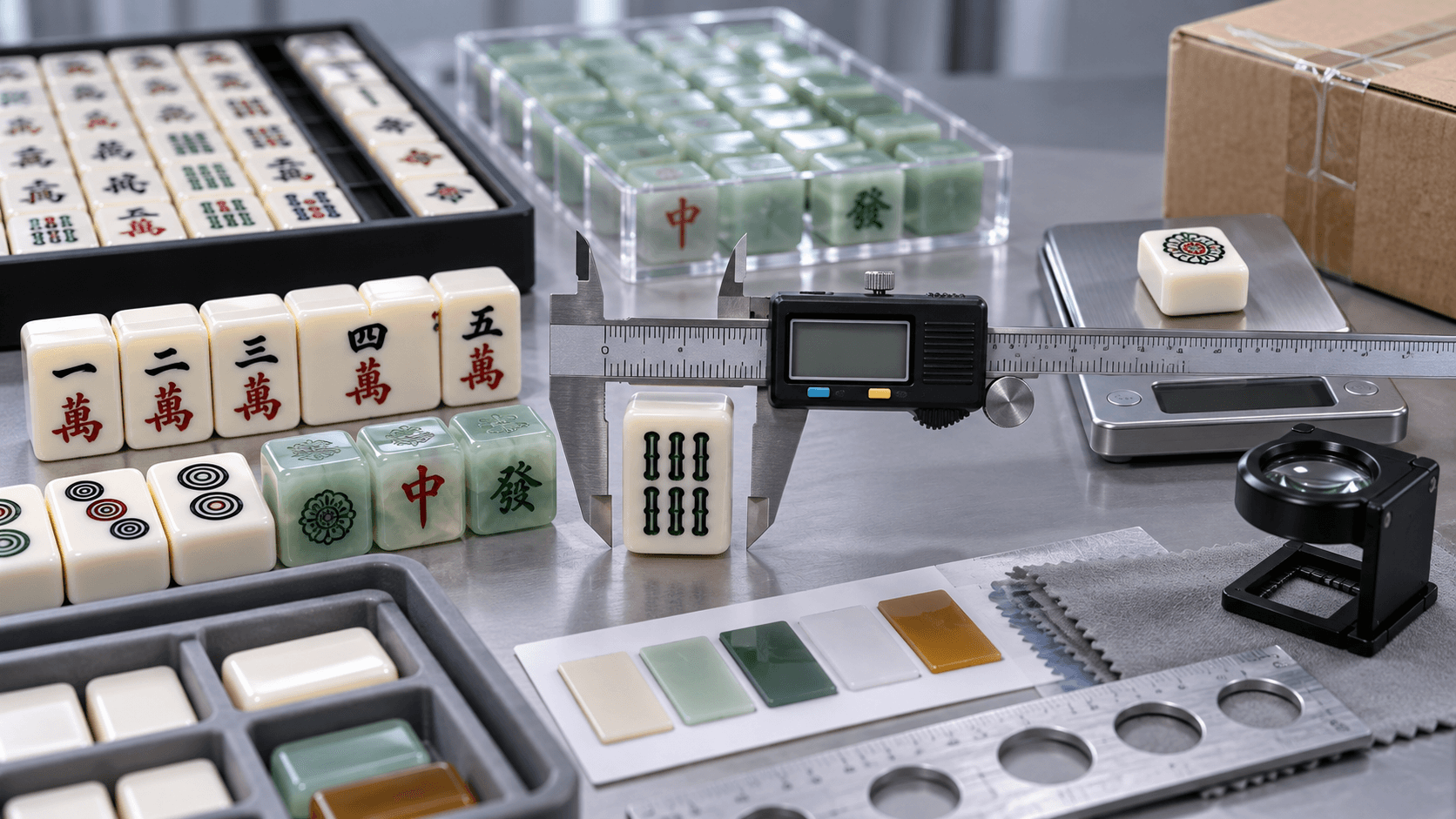
The right comparison is physical. Ask for representative samples made on the proposed construction and color. A generic engraved plastic sample cannot settle how a particular line width, finish, or fill behaves on the intended tile.
Prepare vectors, then inspect at actual size
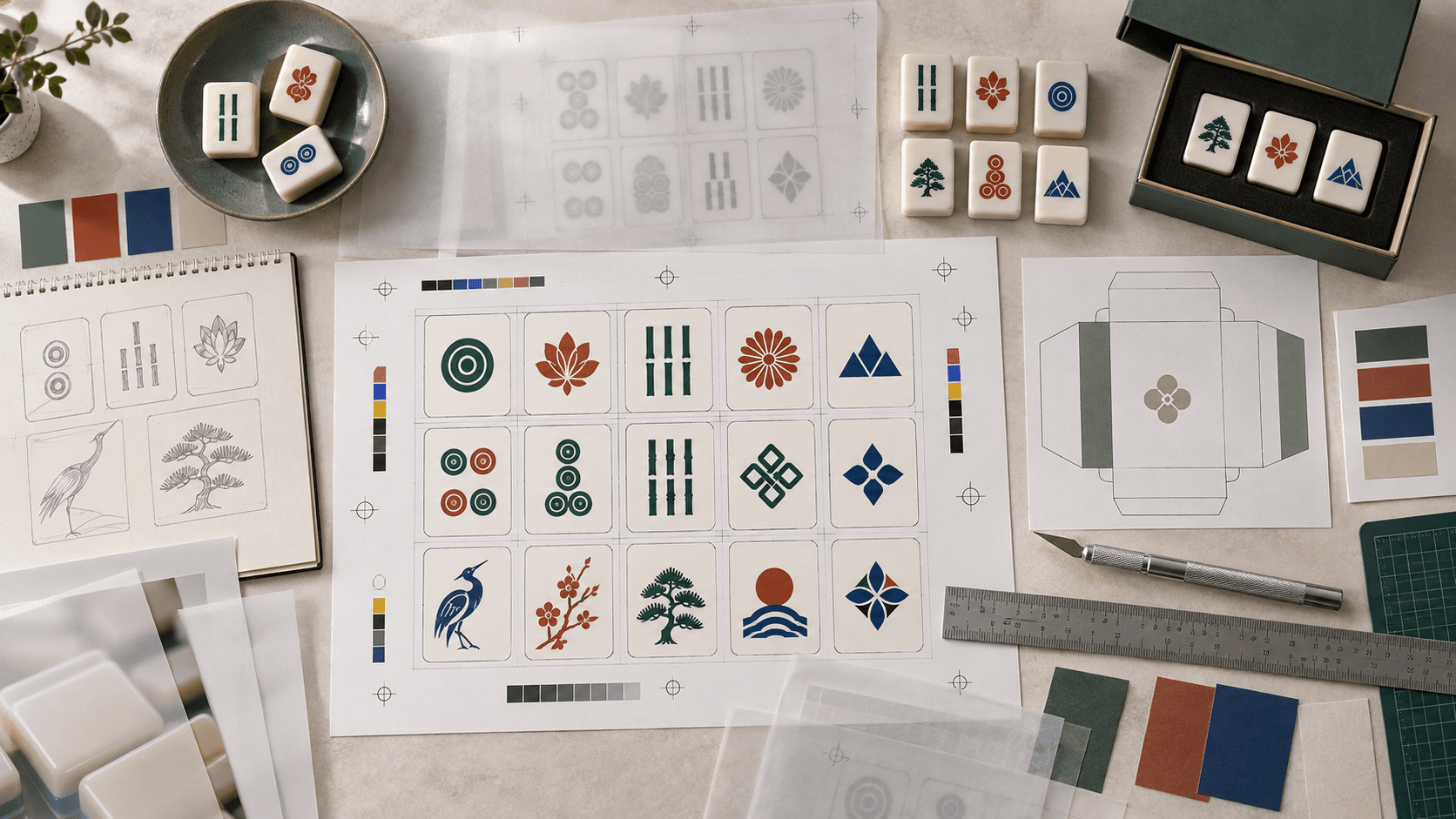
Clean vector paths are useful because the production team can review outlines, joins, gaps, and scale without guessing where a pixel edge belongs. Adobe's current Illustrator FAQ explains that vector graphics are resolution independent and can be resized without the quality loss associated with fixed pixels. That property helps file preparation, but it does not guarantee that every small feature can be produced.
Print a paper proof at the real tile dimensions. View it at a normal playing distance. Check whether similar faces can be distinguished quickly. Then let the manufacturer review minimum line, gap, fill, and edge-clearance needs for the proposed process. A giant artwork preview on a monitor hides problems that are obvious in the hand.
How laser engraved mahjong tiles should be sampled
Do not sample only the easiest face. Choose a small challenge set: the densest symbol, the thinnest approved line, the smallest text, the largest filled area, a face near the edge limit, and at least one repeated design. Include the front and back if both use the process.
The sample review should answer four separate questions. Is the mark complete? Is it legible? Is the contrast stable across pieces? Does the surface feel and clean as expected? A positive answer to one does not imply the others.
Color fill changes the inspection
An unfilled recess depends on shadow and material contrast. A filled recess adds another material and another operation. The buyer should define the intended fill color, edge cleanliness, coverage, and acceptable appearance around the recess. Review the filled result under consistent lighting, not through a heavily edited photograph.
Ask whether the sample uses the same substrate color, surface finish, recess preparation, and fill system proposed for production. If any part differs, record the sample as directional rather than final.
| Review point | What to observe | How to record it |
|---|---|---|
| Line continuity | Breaks, merged gaps, weak corners | Face ID plus close photograph |
| Position | Centering, rotation, edge clearance | Measurement or approved overlay |
| Depth and touch | Sharpness, roughness, unexpected ridges | Approved sample and written limit |
| Fill appearance | Voids, overflow, uneven coverage | Defect examples by severity |
| Set consistency | Variation between repeated faces and batches | Side-by-side contact sheet |
| Cleaning | Residue retained in recesses after normal care | Agreed care method and observation |
Decide where engraving stops
Complex art sometimes benefits from a mixed process. A buyer may keep a simple engraved logo while printing multicolor faces, or engrave selected marks and use another method for gradients. Mixed processes add coordination, so the face schedule must state which treatment applies to every design.
Do not leave the decision inside filenames alone. Add columns for process, color, quantity, orientation, and approval status. That schedule becomes the bridge between the creative team and the production team.
Keep a separate line for mirrored, rotated, or paired artwork. A repeated motif can look correct in one preview and still be applied in the wrong direction on the physical tile. Mark the top edge on proofs and sample photographs. When backs are directional, arrange several tiles as they would appear during play; a single upright image will not reveal whether the repeated field feels consistent.
For translated labels, release the wording and the geometry together. A supplier can check whether the lines are manufacturable, but the buyer must approve spelling, meaning, and regional usage. Locking the language after the path work reduces the chance that a late text correction changes spacing across many faces.
Account for edges, corners, and repeated handling
A drawing is flat; a tile is handled from every side. Keep important elements away from transitions that may alter their appearance. Review the face after all relevant finishing steps, not immediately after marking. Ask for several pieces rather than one showcase sample so normal variation is visible.
Use-condition testing should match the buyer's intended product. A club set may experience frequent shuffling and cleaning. A gift set may be judged first by visual finish and presentation. The test plan should reflect those scenarios without making unsupported lifetime claims.
Care instructions matter too. Ask which ordinary cleaning methods are compatible with the approved material and filled detail, then write a short instruction for the end user. Do not invent a universal solvent or scrub test. The same cleaner can behave differently on a printed surface, a color-filled recess, and a polished transparent edge.
Rights clearance belongs before the sample
Engraving a supplied logo does not establish permission to use it. WIPO describes a trademark as a sign that distinguishes one enterprise's goods or services and explains that registration can give the owner an exclusive right to use or license the mark. Its trademark overview is a useful starting reference, while buyers should obtain advice for their markets and assets.
Send written approval for licensed marks, characters, artwork, and typefaces before production work. Identify which party can approve placement and changes. This is especially important when a manufacturer receives files through an agency rather than directly from the rights holder.
Build an RFQ around evidence
- Tile construction, dimensions, base color, and surface finish
- Exact face schedule and repeated quantities
- Vector source files with outlined or packaged fonts as agreed
- Actual-size proof and a visual contact sheet
- Engraved positions, orientation, and safe area
- Filled or unfilled treatment, including color reference
- Challenge faces selected for early sampling
- Inspection language for line, position, surface, and consistency
- Packaging and accessories that may touch the marked surfaces
- Quantity, destination, and target in-use date
This pack gives the supplier something testable. It also makes later revisions easier to price and schedule because the released starting point is visible.
FAQ
Is engraving automatically more durable than printing?
No universal answer applies. Durability depends on the exact material, marking or fill system, finishing, handling, cleaning, and production controls. Test the proposed construction under relevant use.
Can photographs be engraved directly?
A photograph may need substantial conversion or a different process. Ask the supplier to evaluate tonal detail, scale, contrast, and the intended material before committing to the artwork.
Why request vector files?
Vectors give clearer control of paths, line widths, and scale. The supplier still needs to confirm process limits and may request a specific file setup.
Can very small text be used?
Only after actual-size review and a physical process sample. Letter shape, spacing, depth, fill, and material contrast all influence legibility.
Should every face be sampled?
The buyer can begin with representative challenge faces, but the complete face schedule and final proof still require approval. Decide whether a full pre-production set is needed for the project's risk.
How is engraving position approved?
Use dimensions, an overlay, or a clearly marked physical sample. Avoid approving placement only from an angled photograph.
Can one setting work across several colors?
Do not assume so. Base color and construction can change visible contrast and fill behavior. Review each production colorway that matters.
What is a challenge face?
It is an artwork sample selected because it contains the most demanding approved feature, such as a narrow gap, dense mark, small label, or broad filled area.
How should defects be described?
Use observable language: missing segment, merged gap, fill outside recess, wrong orientation, rough edge, or position beyond an agreed limit. Attach a photograph and face ID.
Can engraving and printing appear on one tile?
Possibly, subject to the material and process review. Specify order, position, color, finish, and inspection points, then approve a representative physical sample.
Review the process against the whole set
ABC Mahjong offers custom artwork, colors, molds, packaging, and coordinated accessories. Explore the custom service, see the product range, and read about the manufacturing approach. Send your files and challenge designs through the contact page so the team can assess whether laser engraved mahjong tiles suit the visual and commercial brief.